1. Square-Based Pyramid (Most Important Solid)
Key Words You Must Remember
- a = side of square base
- h = vertical height (perpendicular from apex to base centre)
- l = slant height (height of triangular face)
- e = lateral edge (line from apex to base corner)
Must-Know Relations (write these 10 times!)
- l² = h² + (a/2)²
- e² = l² + (a/2)² or e² = h² + (a√2/2)²
- Half of base diagonal = a√2 / 2
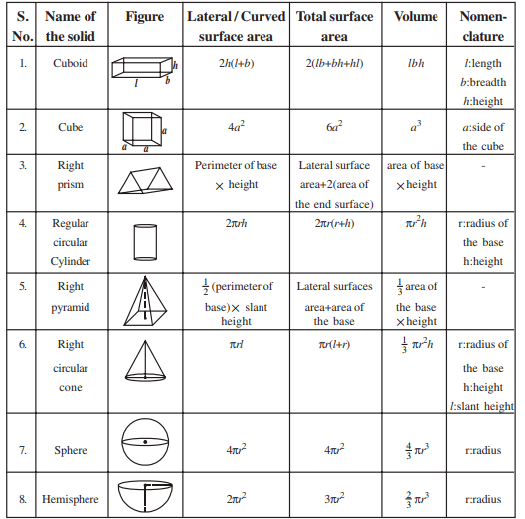
Surface Area (Never forget)
- Area of 1 triangle = (1/2) × a × l
- Lateral surface area (LSA) = 4 × (1/2)al = 2al
- Total surface area (TSA) = a² + 2al = a(a + 2l)
Volume (Easiest formula in the chapter) Volume = (1/3) × base area × height = (1/3) a² h
Trick Questions & How to Solve Fast
- Given TSA = 144 cm², l = 5 cm → a(a + 10) = 144 → a² + 10a – 144 = 0 → a = 8 cm
- Given volume = 384 cm³, a = 12 cm → h = 8 cm → l = 10 cm → LSA = 240 cm²
2. Cone (Second Most Important)
Relations (memorize forever) l² = h² + r² → l = √(h² + r²)
Surface Area
- Curved surface area (CSA) = π r l
- Total surface area (TSA) = π r² + π r l = π r (r + l)
Volume Volume = (1/3) π r² h
Fast Tricks
- If TSA = 2816 cm² and r + l = 64 → πr × 64 = 2816 → r = 14 cm → l = 50 cm
- Ratio r : h = 5 : 12 and volume = 314.86 cm³ → r = 5 cm, h = 12 cm, l = 13 cm
3. Combined Solids – Formula Table (Copy in Notebook)
CombinationTotal Surface Area (for painting)VolumeCylinder + Coneπr² + 2πr h₁ + πr lπr²h₁ + (1/3)πr²h₂Cone + Hemisphere (ice-cream)πr l + 2πr² = πr(l + 2r)(1/3)πr²h + (2/3)πr³Cylinder + Hemisphere2πr h + 3πr²πr²h + (2/3)πr³Two Cones (joined at base)πr(l₁ + l₂)(1/3)πr²(h₁ + h₂)Prism + Pyramida² + 4a h₁ + 2a la²h₁ + (1/3)a²h₂
Very Important Rule for Painting/Costing → Do NOT count the two faces that are joined together (they are inside).
Example: Pencil (cylinder + cone) TSA = πr² (base) + 2πr h (cylinder) + πr l (cone) → πr(r + 2h + l)
4. Cost Estimation & Real-Life Problems (Exam Favorites)
SituationWhat to FindFormula / TrickWater tank capacityVolume × 1000 = litres1 m³ = 1000 litres, 1 ft³ ≈ 28.3 litresIrregular land (trapezium shape)Area(1/2) × diagonal × (sum of two perpendiculars)Painting room2h(l+b) + lb – doors/windowsSubtract door & window areaFencingPerimeter × roundsTotal wire = perimeter × 5 (if 5 rounds)Bricks/TilesTotal area ÷ area of 1 brickRound up if answer is decimal
5. Top 10 Golden Questions (Directly from Past Exams)
- Square pyramid: a = 12 cm, l = 10 cm → TSA = 384 cm², Volume = 512 cm³, h = 8 cm
- Cone: diameter 14 cm, h = 48 cm → r = 7 cm, l = 50 cm, Volume = 1232 cm³
- Ice-cream cone: r = 21 cm, total volume 32340 cm³ → h = 28 cm, TSA = 5082 cm²
- Pencil: r = 7 cm, cylinder 39 cm, cone 24 cm → TSA = 2420 cm², Volume = 7238 cm³
- Two cones joined: common r = 3 cm, total height 20 cm → Volume = 188.57 cm³
- Tank capacity: square base 3 m side, height 4 m → 36,000 litres
- Cost of painting room 14 ft × 12 ft × 10 ft (with doors/windows) → Rs. 19,380
- Pyramid on pillar: base 4 ft, pillar 10 ft, pyramid 2 ft → slant height ≈ 2.83 ft
- Cone tent cloth: CSA = 77 m², l = 14 m → r = 1.75 m, base area ≈ 9.62 m²
- Combined toy cost comparison → always calculate TSA before & after change
Final Revision One-Liner for Each Topic
- Pyramid → Volume always 1/3, TSA = a(a + 2l)
- Cone → l = √(h² + r²), TSA = πr(r + l)
- Combined → Add volumes, subtract joined faces for painting
- Cost → Area × rate, Volume × 1000 = litres
Important questions for practice
1. Square-Based Pyramid
Q1: Base side a=12a = 12a=12 cm, slant height l=10l = 10l=10 cm. Find TSA, Volume, and height hhh.
Solution:
TSA: a(a+2l)=12(12+20)=12×32=384a(a + 2l) = 12(12 + 20) = 12 × 32 = 384a(a+2l)=12(12+20)=12×32=384 cm²
Height: l2=h2+(a/2)2→102=h2+62→h2=64→h=8l^2 = h^2 + (a/2)^2 → 10^2 = h^2 + 6^2 → h^2 = 64 → h = 8l2=h2+(a/2)2→102=h2+62→h2=64→h=8 cm
Volume: V=1/3×a2×h=1/3×144×8=384V = 1/3 × a^2 × h = 1/3 × 144 × 8 = 384V=1/3×a2×h=1/3×144×8=384 cm³
Q2: TSA = 144 cm², slant height l=5l = 5l=5 cm. Find base side aaa.
Solution:
TSA = a(a+2l)→a(a+10)=144→a2+10a−144=0a(a + 2l) → a(a + 10) = 144 → a^2 + 10a − 144 = 0a(a+2l)→a(a+10)=144→a2+10a−144=0
Solve quadratic: a=8a = 8a=8 cm (positive root)
Q3: Volume = 384 cm³, base a=12a = 12a=12 cm. Find height hhh and slant height lll.
Solution:
Volume formula: V=1/3a2h→384=1/3×144×h→h=8V = 1/3 a^2 h → 384 = 1/3 × 144 × h → h = 8V=1/3a2h→384=1/3×144×h→h=8 cm
Slant height: l2=h2+(a/2)2→l2=64+36=100→l=10l^2 = h^2 + (a/2)^2 → l^2 = 64 + 36 = 100 → l = 10l2=h2+(a/2)2→l2=64+36=100→l=10 cm
2. Cone
Q4: Radius r=7r = 7r=7 cm, height h=24h = 24h=24 cm. Find slant height, CSA, TSA, Volume.
Solution:
Slant height: l=√(h2+r2)=√(576+49)=√625=25l = √(h^2 + r^2) = √(576 + 49) = √625 = 25l=√(h2+r2)=√(576+49)=√625=25 cm
CSA = π r l = 3.14 × 7 × 25 ≈ 549.5 cm²
TSA = π r (r + l) = 3.14 × 7 × 32 ≈ 703 cm²
Volume = 1/3 π r^2 h = 1/3 × 3.14 × 49 × 24 ≈ 1231.7 cm³
Q5: TSA = 2816 cm², r + l = 64 → find r and l.
Solution:
TSA = π r (r + l) = 3.14 r × 64 = 2816 → r × 64 = 896 → r = 14 cm
l = 64 − r = 50 cm
Q6: Ratio r:h = 5:12, Volume = 314.16 cm³. Find r, h, l.
Solution:
Let r = 5x, h = 12x
Volume = 1/3 π r^2 h → 1/3 × 3.14 × (25x^2) × 12x = 314.16 → 314 x^3 ≈ 314.16 → x ≈ 1
r = 5 cm, h = 12 cm
Slant height: l = √(r^2 + h^2) = √(25 + 144) = √169 = 13 cm
3. Cylinder
Q7: Cylinder r = 7 cm, h = 20 cm. Find CSA, TSA, Volume.
Solution:
CSA = 2 π r h = 2 × 3.14 × 7 × 20 ≈ 879.2 cm²
TSA = CSA + 2 π r^2 = 879.2 + 2 × 3.14 × 49 ≈ 879.2 + 307.72 ≈ 1186.92 cm²
Volume = π r^2 h = 3.14 × 49 × 20 ≈ 3077.2 cm³
Q8: Cylinder Volume = 1540 cm³, r = 7 cm → find h and TSA.
Solution:
Volume = π r^2 h → 1540 = 3.14 × 49 × h → 1540 / 153.86 ≈ 10 cm → h = 10 cm
CSA = 2 π r h = 2 × 3.14 × 7 × 10 ≈ 439.6 cm²
TSA = CSA + 2 π r^2 = 439.6 + 2 × 3.14 × 49 ≈ 439.6 + 307.72 ≈ 747.32 cm²
4. Combined Solids
Q9: Pencil: Cylinder r = 2 cm, h = 10 cm; Cone height = 5 cm. Find TSA, Volume.
Solution:
Cone slant height: l = √(r^2 + h^2) = √(4 + 25) = √29 ≈ 5.385 cm
Cylinder CSA = 2 π r h = 2 × 3.14 × 2 × 10 ≈ 125.6 cm²
Cone CSA = π r l = 3.14 × 2 × 5.385 ≈ 33.8 cm²
Base area = π r^2 = 3.14 × 4 ≈ 12.56 cm²
TSA = 125.6 + 33.8 + 12.56 ≈ 171.96 cm²
Volume = Cylinder: π r^2 h = 3.14 × 4 × 10 ≈ 125.6 cm³, Cone: 1/3 π r^2 h = 1/3 × 3.14 × 4 × 5 ≈ 20.93 → Total ≈ 146.53 cm³
Q10: Ice-cream cone: r = 7 cm, h = 12 cm (cone) + hemisphere r = 7 cm. Find TSA, Volume.
Solution:
Cone slant height: l = √(h^2 + r^2) = √(144 + 49) = √193 ≈ 13.89 cm
Cone CSA = π r l = 3.14 × 7 × 13.89 ≈ 304.4 cm²
Hemisphere surface = 2 π r^2 = 2 × 3.14 × 49 ≈ 307.72 cm²
TSA = 304.4 + 307.72 ≈ 612.12 cm²
Volume = Cone: 1/3 π r^2 h = 1/3 × 3.14 × 49 × 12 ≈ 615.36 cm³, Hemisphere: 2/3 π r^3 = 2/3 × 3.14 × 343 ≈ 718.77 cm³ → Total ≈ 1334.13 cm³
Q11: Two cones joined at base, r = 3 cm, heights = 8 cm and 12 cm → Volume and TSA
Solution:
Volume = 1/3 π r^2 (h1 + h2) = 1/3 × 3.14 × 9 × 20 = 60 × 3.14 ≈ 188.4 cm³
Slant heights: l1 = √(3^2 + 8^2) = √73 ≈ 8.54, l2 = √(3^2 + 12^2) = √153 ≈ 12.37
LSA = π r (l1 + l2) = 3.14 × 3 × (8.54 + 12.37) = 9.42 × 20.91 ≈ 197 cm²
Visit this link for further practice!!