1. Definition of Force
Force is a push or a pull that changes or tries to change the state of motion or shape of an object.
It can:
Start or stop motion
Change speed
Change direction
Change shape (stretch, compress, bend)
2. Unit of Force
The SI unit of force is Newton (N).
1 Newton = force required to accelerate a mass of 1 kg by 1 m/s².
3. Effects of Force
Force can:
Move a stationary object
Stop a moving object
Change the speed of an object
Change the direction of an object
Change the shape of an object
4. Types of Force
a) Balanced Force
When equal forces act on an object in opposite directions.
No change in motion.
Example: Book resting on a table.
b) Unbalanced Force
When unequal forces act on an object.
Causes change in motion.
Example: A football starts moving when kicked.
5. Contact and Non-contact Forces
Contact Forces
Applied force
Frictional force
Normal reaction force
Tension force
Non-contact Forces
Gravitational force
Magnetic force
Electrostatic force
6. Newton’s Laws of Motion (Brief SEE-Level)
1st Law – Law of Inertia
An object remains at rest or in uniform motion unless an external force acts on it.
2nd Law – Law of Acceleration
Force = mass × acceleration
F = m × a
3rd Law – Action and Reaction
Every action has an equal and opposite reaction.
7. Friction
Friction is a force that opposes motion between two surfaces.
Depends on:
Nature of surfaces
Normal force
Types of Friction:
Static
Sliding
Rolling
Fluid friction
Advantages: walking, writing, stopping vehicles
Disadvantages: wear and tear, loss of energy
8. Weight as a Force
Weight is the force of gravity acting on a body.
Formula:
Weight (W) = mass (m) × gravity (g)
Measured in Newtons (N).
g ≈ 9.8 m/s² on Earth.
9. Numerical Example
Example:
Find the force when a mass of 4 kg accelerates at 3 m/s².
Solution:
F = m × a = 4 × 3 = 12 N
Gallery
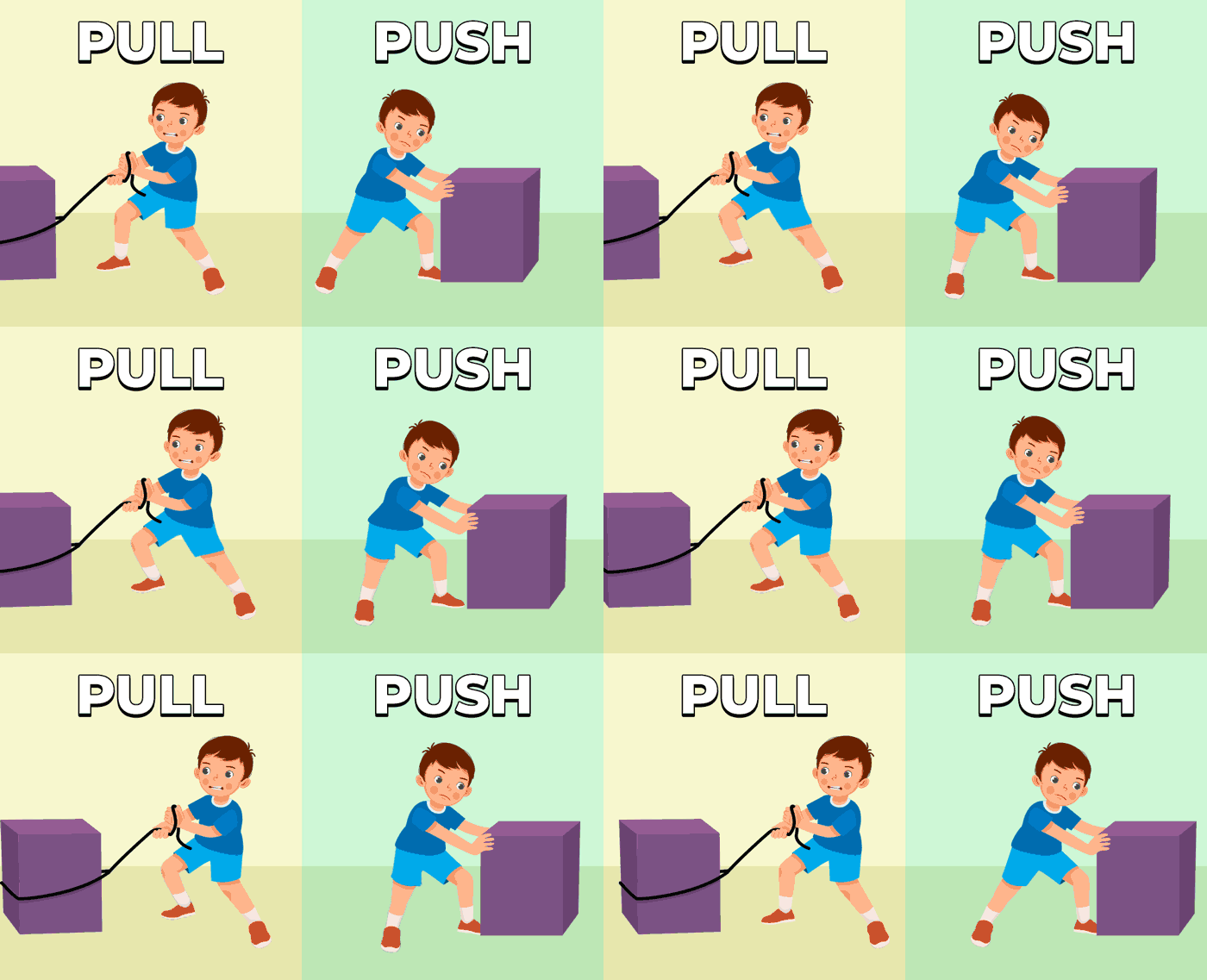
Force
Force