1.Introduction to Evolution
What is Evolution?
Evolution is the process of gradual change in living organisms over generations, where simple organisms develop into more complex ones through genetic changes and adaptation to the environment.
Key Ideas from Section:
- Origin of Life – First living beings were microscopic, single-celled organisms (like bacteria) that appeared millions of years after Earth formed.
- Environmental Influence – Organisms change their body structure in response to changes in climate, geography, food availability, etc.
- Progressive Development – Evolution moves from:
Simple → Complex
Unicellular → Multicellular
Invertebrates → Vertebrates
Non-flowering → Flowering plants
2 Evidences of Evolution
(A) Fossil Evidence
What are fossils?
Traces or remains of ancient organisms preserved in sedimentary rocks.
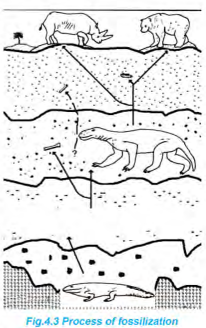
How are fossils formed? (Step-by-step)
- Organism dies and gets buried in mud/sand.
- Over time, layers of sediment accumulate.
- Soft parts decay; hard parts (bones, shells) remain.
- Sediments turn into rock; the imprint/hard part becomes a fossil.
- Found in layers: older (simpler) fossils in lower layers, newer (complex) in upper layers.
Why are fossils strong evidence?
- Show sequence of life from simple to complex.
- Carbon/Uranium dating helps determine age (millions of years).
- Example: Fossil algae (simple) below fossil mammals (complex).
(B) Comparative Morphology & Anatomy
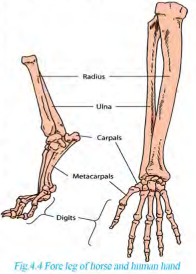
1. Homologous Organs
Same origin, different functions.
Indicates common ancestor.
Example:
- Human hand, horse leg, bat wing, whale flipper
- All have same bone arrangement: humerus, radius, ulna, carpals, metacarpals, phalanges.
2. Analogous Organs
- Different origin, same function.
- No common ancestor; similar due to similar needs.
- Example:
Insect wing (membrane) vs. Bird wing (feathers & bones) – both used for flying.
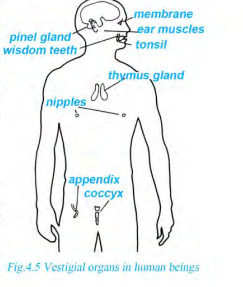
3. Vestigial Organs
- Reduced/functionless organs that were functional in ancestors.
- Proof of evolutionary history.
- Human Examples:
- Appendix – once helped digest cellulose.
- Tailbone (Coccyx) – remnant of tail.
- Wisdom teeth – used for tough plant diet.
- Ear muscles – once moved ears like animals.
- Nictitating membrane – third eyelid remnant.
(C) Bridge Animals / Connecting Links
- Organisms that show characteristics of two different groups.
- Act as "missing links" in evolution.
Examples:
- Platypus –
- Lays eggs (like reptiles/birds)
- Feeds milk (like mammals)
- Has duck-like bill, fur
- Archaeopteryx (fossil) –
- Teeth & long tail (reptile features)
- Feathers & wings (bird features)
- Protopterus (lungfish) –
- Gills (fish feature)
- Lungs (amphibian feature)
Significance: Shows gradual transition from one group to another.

(D) Embryological Evidence
- Early embryos of fish, salamander, tortoise, chicken, human look very similar.
- All have gill slits, tail, simple limb buds in early stages.
- Suggests common vertebrate ancestor.

3 Theories of Evolution
I. Lamarckism (Lamarck's Theory)
Main Principles:
- Environmental Effect – Environment changes → needs change.
- Use and Disuse – Organs used more develop; unused degenerate.
- Inheritance of Acquired Characters – Traits developed during lifetime are passed to offspring.
Example – Giraffe’s Neck:
- Short-necked ancestors stretched necks to reach leaves.
- Neck lengthened due to use.
- Longer neck passed to next generation → over time, long-necked giraffes evolved.
Criticism:
- No genetic basis – Acquired traits (like muscles) don’t change DNA.
- Not inherited – Example: If you cut a mouse’s tail, babies still have tails.
II. Darwinism (Darwin's Theory of Natural Selection)
Five Main Points:
Overproduction / Enormous Fertility
- More offspring produced than can survive.
- Example: Elephant pair → millions possible, but population stable.
Struggle for Existence
- Competition for food, space, mates, shelter.
- Types:
- Intraspecific (same species)
- Interspecific (different species)
- Environmental (against climate, disasters)
Variation & Heredity
- Individuals in a species vary (size, color, etc.).
- Variations are inherited (passed to offspring).
Natural Selection / Survival of the Fittest
- Individuals with favorable variations survive and reproduce.
- Unfavorable traits → eliminated.
- Nature "selects" the fittest.
Origin of New Species
- Over many generations, favorable traits accumulate.
- Population becomes very different from ancestors → new species forms.
Criticism of Darwinism:
- Did not explain source of variation.
- Did not know about genes/mutations.
- Could not explain harmful traits.
III. Hugo de Vries' Mutation Theory
What is Mutation?
- Sudden, heritable change in DNA/chromosomes.
- Causes new traits not seen in parents.
- Examples: Six-fingered hand, hairless mice.
Main Points:
- New species arise from large mutations (not small variations).
- Mutations appear suddenly.
- Inherited if in reproductive cells.
- Nature selects beneficial mutations.
- Mass mutation leads to new species.
Example: Evening Primrose (Oenothera) showed different chromosome numbers (15, 16, 20, 22) due to mutation.
Criticism:
- Most mutations harmful/recessive.
- Doesn’t explain direction of evolution.
- Oenothera was later found to be a hybrid, not pure mutation example.
Variation vs Mutation
| Feature | Aspect Variation (Small differences) | Mutation (Sudden, large genetic change) |
|---|---|---|
| Definition | Small differences among same species | Sudden, large genetic change |
| Cause | Environment + genes | Radiation, chemicals, errors in DNA copying |
| Inheritance | May or may not be inherited | Inherited if in sex cells |
| Type | Continuous, gradual | Discontinuous, sudden |
| Example | Skin color, height in humans | Six fingers, albinism |
| Role in Evolution | Provides raw material for natural selection | Creates entirely new traits quickly |
Types of Variation:
- Somatogenic – Acquired traits (muscles, skills) → not inherited.
- Blastogenic – Genetic traits (eye color) → inherited.
- Environmental – Due to environment (tanning, plant height in shade/sun).