1. Right-Angled Triangle
A triangle with one angle equal to 90° is called a right-angled triangle.
Let triangle ABC be right-angled at C.
Key Elements
Hypotenuse: Side opposite the right angle (longest side).
Perpendicular: Side opposite the angle θ.
Base: Side adjacent to angle θ.
Formulas
(a) Area of a Right-Angled Triangle
Area = 1/2 × base × height
(b) Pythagoras Theorem
(Hypotenuse)^2 = (Base)^2 + (Perpendicular)^2
(c) Trigonometric Ratios (for angle θ)
sin θ = Perpendicular / Hypotenuse
cos θ = Base / Hypotenuse
tan θ = Perpendicular / Base
(d) Common Values of Trigonometric Ratios
θ0°30°45°60°90°sin θ01/21/√2√3/21cos θ1√3/21/√21/20tan θ01/√31√3∞Example:
If AB = 6 cm, AC = 10 cm, find BC using Pythagoras theorem:
BC^2 + AB^2 = AC^2
BC^2 + 6^2 = 10^2
BC = 8 cm
Trigonometric ratios for ∠A:
sin A = BC / AC = 8 / 10 = 0.8
cos A = AB / AC = 6 / 10 = 0.6
tan A = BC / AB = 8 / 6 = 4 / 3
2. Angle of Elevation and Depression
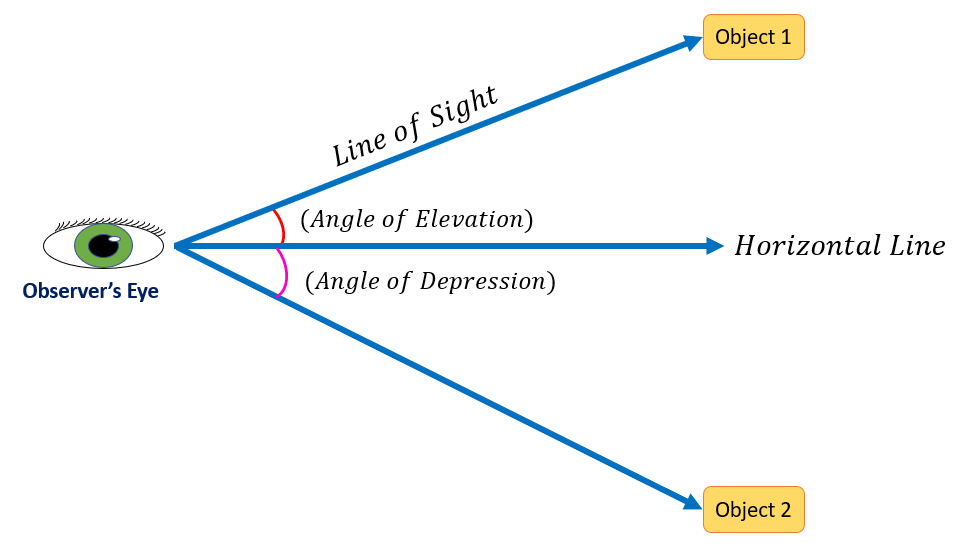
Angle of Elevation: Angle formed by line of sight above horizontal when looking up at an object.
Angle of Depression: Angle formed by line of sight below horizontal when looking down.
Key Points:
Draw a line parallel to the ground from observer’s eye.
Angle of elevation = angle between line of sight and horizontal when looking up.
Angle of depression = angle between line of sight and horizontal when looking down.
Measured using a clinometer.
Observations:
Angle of elevation increases when object is closer.
Angle of depression increases when observer is closer to the object.
3. Applications of Trigonometry
Right-Triangle Relationships
tan θ = (Height of object − Observer height) / Distance from object
sin θ = (Height of object − Observer height) / Hypotenuse
4. Key Formulas for Solving Problems
Trigonometric ratios:
sin θ = Opposite / Hypotenuse
cos θ = Adjacent / Hypotenuse
tan θ = Opposite / Adjacent
Height of object:
Height = (tan θ × distance) + observer height
Distance of object:
Distance = (Height of object − observer height) / tan θ
Pythagoras theorem:
Hypotenuse^2 = Perpendicular^2 + Base^2
Angle from shadow:
tan θ = Height of object / Shadow length
5. Solved Examples (Basic & Important)
Example 1: Find height of tree
Angle of elevation = 45°, distance = 20 m, observer height = 1.8 m
tan 45° = (h − 1.8) / 20 ⇒ h = 21.8 m
Example 2: Distance to tower
Height = 140 m, angle = 60°
tan 60° = 140 / x ⇒ x = 80.83 m
Example 3: Broken tree
Height = 18 m, angle = 30°
sin 30° = (18 − x) / x ⇒ x = 12 m (broken part)
Example 4: Pole in circular pond
Height = 50 m, radius = 50 m
tan θ = 50 / 50 ⇒ θ = 45°
Example 5: Angle of depression to house
Tower height = 60 m, distance to house = 20 m, angle of depression = 45°
tan 45° = (60 − h) / 20 ⇒ h = 40 m (height of house)
Example 6: Two towers and distance between them
Two towers: 50 m and 30 m. Angles of elevation = 45° and 60°
tan 45° = 50 / x ⇒ x = 50 m
tan 60° = 30 / y ⇒ y = 30 / √3 ≈ 17.32 m
Example 7: Height of building using shadow
Shadow = 24 m, angle of elevation = 30°
tan 30° = h / 24 ⇒ h = 24 / √3 ≈ 13.86 m
Example 8: Observation tower problem
Observer height = 2 m, angles = 45° & 60°, walks 10 m closer
Let initial distance = x + 10
tan 45° = (h − 2) / (x + 10) ⇒ h − 2 = x + 10
tan 60° = (h − 2) / x ⇒ h − 2 = x√3
Solve: x ≈ 17.32 m, h ≈ 32 m
Example 9: Two points on opposite bank
Tree = 20 m, angles of elevation = 30° & 60°
tan 30° = 20 / x ⇒ x ≈ 34.64 m
tan 60° = 20 / y ⇒ y ≈ 11.55 m
Width of river = x + y ≈ 46.19 m
Example 10: Building on hill
Building = 50 m, hill = 30 m, angles = 60° & 45°
tan 45° = 30 / x ⇒ x = 30 m
tan 60° = 80 / x ⇒ x ≈ 46.19 m
Example 11: Ship approaching lighthouse
Lighthouse = 40 m, angles = 30° & 45°, ship sails 20 m closer
tan 30° = 40 / (x + 20) ⇒ x ≈ 49.28 m
Example 12: Pole leaning on another pole
Poles = 20 m & 15 m, distance = 10 m
tan θ = 5 / 10 ⇒ θ ≈ 26.57°
Example 13: Plane observation
Plane height = 500 m, angle = 30°
tan 30° = 500 / x ⇒ x ≈ 866.03 m
Example 14: Angle of depression from cliff
Cliff = 60 m, angles to boats = 30° & 45°
Distance to first boat = 60 / tan 30° ≈ 103.92 m
Distance to second boat = 60 / tan 45° = 60 m
Distance between boats ≈ 43.92 m
Example 15: Tree broken at top
Tree = 18 m, top touches ground 12 m from base
√(x^2 + 12^2) = 18 − x ⇒ x = 9 m (broken height)
Example 16: Two towers and observer
Towers = 60 m & 40 m, observer = 50 m from first, angle to second = 30°
tan 30° = 40 / (d − 50) ⇒ d ≈ 73.09 m
6. Important Notes for Exam
Remember trigonometric ratios for 0°, 30°, 45°, 60°, 90°.
Use Pythagoras theorem to find unknown sides.
Draw figure carefully; mark horizontal line for angles.
Closer object → larger angle of elevation; farther → smaller.
Convert height/distance problems into right triangles.
Practice Link:
https://besidedegree.com/exam/s/academic