1. Introduction to Matter and Elements
- Matter exists as elements (e.g., gold, silver, copper – metals; sulphur, iodine – non-metals) and compounds.
- 118 elements discovered; millions of compounds formed from limited elements.
- Atom: Smallest particle of an element that takes part in chemical reactions.
- All atoms of same element are identical; different elements have different atoms.
- Some atoms (inert gases) are chemically inert.
2. Structure of an Atom
- Average diameter of atom: 10⁻¹⁰ m.
- Subatomic particles:
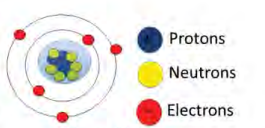 ParticleChargeLocationProtonPositiveNucleusNeutronNeutralNucleusElectronNegativeOrbits/shells around nucleus
- Nucleus contains protons + neutrons; electrons revolve in fixed orbits (shells).
3. Electronic Configuration (Shells: K, L, M, N)
- Maximum electrons in a shell: 2n² (n = shell number).
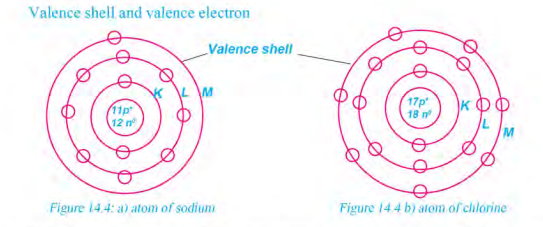
- K shell (n=1): 2 electrons
- L shell (n=2): 8 electrons
- M shell (n=3): 18 electrons
- N shell (n=4): 32 electrons
4. Stability Rules
- Duplet rule: K-shell complete with 2 electrons → stable (e.g., He: 2 electrons).
- Octet rule: Outermost shell complete with 8 electrons → stable (e.g., Ne, Ar, Kr, Xe, Rn).
- Inert gases are stable, do not react, found free in nature.
5. Valence Shell, Valence Electrons, and Valency
- Valence shell: Outermost shell.
- Valence electrons: Electrons in valence shell (participate in reactions).
- Valency: Combining capacity = number of electrons an atom can lose, gain, or share to achieve duplet/octet.
Valency Table (Atomic No. 1–20)
ElementSymbolAtomic No.Config (K L M)ValencyHydrogenH111HeliumHe220LithiumLi32,11BerylliumBe42,22BoronB52,33CarbonC62,44NitrogenN72,53OxygenO82,62FluorineF92,71NeonNe102,80SodiumNa112,8,11MagnesiumMg122,8,22AluminiumAl132,8,33SiliconSi142,8,44PhosphorusP152,8,53,5SulphurS162,8,62,6ChlorineCl172,8,71ArgonAr182,8,80PotassiumK192,8,8,11CalciumCa202,8,8,22
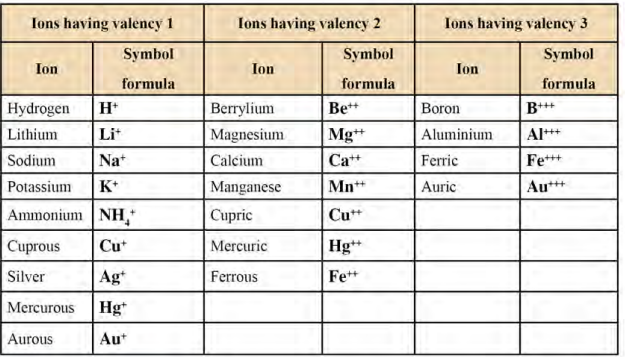
- Some elements show variable valency (e.g., Fe: 2,3; Cu: 1,2; Au: 1,3).
6. Ions
- Atoms become charged by losing/gaining electrons → ions.
- Cation (+ve): Formed by loss of electrons (metals) → e.g., Na⁺, Mg²⁺, Al³⁺.
- Anion (–ve): Formed by gain of electrons (non-metals) → e.g., Cl⁻, O²⁻.
7. Chemical Bonds
- Force that holds atoms together in compounds.
- Types studied:
- Electrovalent/Ionic Bond: Transfer of electrons (metal + non-metal).
- Forms ionic compounds (high MP/BP, soluble in water, conduct when dissolved).
- Examples: NaCl, MgO, CaCl₂.
- Covalent Bond: Sharing of electrons (non-metal + non-metal).
- Forms covalent compounds (low MP/BP, insoluble in water).
- Single (-), double (=), triple (≡) bonds possible.
- Examples: H₂O, CH₄, NH₃, HCl.
- Electrovalent/Ionic Bond: Transfer of electrons (metal + non-metal).
8. Molecular Formula
- Symbol representation of a molecule (shows types and number of atoms).
- Criss-cross method to write formula:
- Write symbols → write valencies above → criss-cross → simplify.
- Example: Aluminium oxide → Al³⁺ O²⁻ → Al₂O₃.
9. Atomic Mass and Molecular Mass
- Atomic mass ≈ protons + neutrons (in amu).
- Molecular mass = sum of atomic masses of all atoms in molecule.
Method of Writing Molecular Formula (Criss-Cross Method)
The textbook explains the criss-cross method as the standard way to write the molecular formula of compounds, especially ionic (electrovalent) compounds. Here are the step-by-step rules as given in the chapter:
Steps:
- Write the name of the compound (e.g., Magnesium chloride).
- Write the symbols of the elements/ions side by side (usually metal first). Example: Mg Cl
- Write the valency of each element/ion above the symbols. Example: Magnesium Chloride 2 1 Mg Cl
- Criss-cross the valencies (exchange them) and write them as subscripts (below) on the opposite sides. Example: 2 1 Mg Cl ↓ ↓ Mg₁ Cl₂ → MgCl₂ (The subscript 1 is not written.)
- If the subscript is more than 1 for a polyatomic ion (like SO₄²⁻, HCO₃⁻, etc.), put the ion in brackets () and write the subscript outside. Example: Magnesium bicarbonate Mg²⁺ (HCO₃)⁻ ↓ ↓ Mg₁ (HCO₃)₂ → Mg(HCO₃)₂
- Simplify if possible (divide subscripts by common factor), but this is rare.
Examples from the Textbook (Page 239)
CompoundSymbols with ValenciesCriss-Cross ResultFinal FormulaSodium chlorideNa¹ Cl¹Na₁Cl₁NaClCalcium chlorideCa² Cl¹Ca₁Cl₂CaCl₂Aluminium chlorideAl³ Cl¹Al₁Cl₃AlCl₃Carbon tetrachlorideC⁴ Cl¹C₁Cl₄CCl₄Boron oxideB³ O²B₂O₃B₂O₃Ammonium sulphateNH₄¹ SO₄²(NH₄)₂SO₄(NH₄)₂SO₄Calcium sulphateCa² SO₄²Ca₂SO₄₂ → divide by 2CaSO₄Aluminium nitrateAl³ NO₃¹Al₁(NO₃)₃Al(NO₃)₃Calcium bicarbonateCa² HCO₃¹Ca₁(HCO₃)₂Ca(HCO₃)₂
Important Points to Remember for Exams
- Valency 1 is never written as subscript.
- Polyatomic ions (e.g., SO₄, NO₃, HCO₃, PO₄, OH, CO₃, NH₄) must be in brackets if subscript > 1.
- For covalent compounds (like H₂O, CH₄, NH₃), we usually write them directly from the number of shared electrons, but criss-cross can still be used where valency applies.
10. Nuclear Stability and Radioactivity
1. Nuclear Stability
- The nucleus of an atom is made up of protons (p⁺) and neutrons (n⁰).
- For the nucleus to be stable, the ratio of neutrons to protons (n/p) should be approximately 1 (or slightly more than 1 for heavier elements).
- If the neutron-to-proton ratio is much more than 1, or if the atomic number is very high, the nucleus becomes unstable.
- Instability increases with increase in atomic number.
- Unstable nuclei try to become stable by emitting energetic radiations → this is called radioactive emission.
Condition for stable nucleus: n/p ≈ 1 (or slightly >1)
2. Radioactive Elements and Radioactive Emission
- Elements with high atomic number (mostly atomic number > 83) have unstable nuclei.
- Such elements are called radioactive elements.
- Examples: Uranium (U), Plutonium (Pu), Thorium, Radium, etc.
- To gain stability, they emit three types of powerful radiations:
- Alpha (α) particles
- Beta (β) particles
- Gamma (γ) rays
- The process of emission of these radiations is called radioactive emission or radioactivity.
- These radiations are harmful to human health.
- Radioactivity was discovered by French scientist Henri Becquerel in 1896 AD.
3. Nuclear Fission
- Definition: The process of splitting a heavy unstable nucleus into two or more lighter nuclei is called nuclear fission.
- It is done artificially by bombarding the heavy nucleus (e.g., Uranium or Plutonium) with high-speed neutrons.
- When the nucleus splits:
- Smaller/lighter nuclei are formed.
- Some mass is lost (mass defect).
- The lost mass is converted into a huge amount of energy (along with α, β, γ radiations).
- (Uranium-236 + neutron → Barium-141 + Krypton-92 + 3 neutrons + energy)
- This is the principle behind atomic bombs and nuclear power plants.
4. Nuclear Fusion
- Definition: The process of combining two or more light nuclei to form a heavier nucleus is called nuclear fusion.
- It requires very high temperature and pressure.
- Example (from textbook):
- (Four hydrogen nuclei → one helium nucleus + energy)
- This process continuously happens in the Sun and stars (reason for their heat and light).
- Abundant hydrogen, extreme heat, and pressure in stars make fusion possible.
- We cannot yet produce controlled nuclear fusion artificially on Earth for energy (very difficult to create required conditions).
5. Atomic Energy (Nuclear Energy)
- Energy obtained from nuclear reactions (mainly fission) is called atomic energy or nuclear energy.
- How electricity is produced (nuclear power plant):
- Controlled nuclear fission in a nuclear reactor (kiln) produces huge heat.
- Heat boils water → produces steam.
- Steam runs a steam engine/turbine.
- Turbine runs a generator → produces electricity.
- Used in most developed countries for electricity generation.
Beneficial uses:
- Sterilisation of drinking water, food, medical equipment (using radiations).
- Treatment of diseases like cancer (radiotherapy).
Risks and harmful effects:
- Radiation leakage from reactors.
- Misuse in nuclear weapons (atomic bombs).
- Very dangerous for human health and environment.
Key Points for Exam
- Stable nucleus → n/p ≈ 1
- Radioactive elements → atomic no. > 83 mostly
- Fission → splitting heavy nucleus → used for electricity and bombs
- Fusion → joining light nuclei → happens in Sun
- Atomic energy → boon (electricity, medicine) but also bane (radiation danger)
- Stable nucleus: neutron/proton ratio ≈ 1.
- High atomic number → unstable → radioactive elements (e.g., U, Pu).
- Emit α, β, γ rays.
- Nuclear fission: Heavy nucleus splits → energy (e.g., U → Ba + Kr + energy).
- Nuclear fusion: Light nuclei combine → energy (e.g., 4H → He + energy).
- Atomic energy used for electricity, medicine; harmful if misused.