1. Introduction to Classification of Living Beings
Living beings around us show great diversity in size, shape, structure, habitat, nutrition, and reproduction.
For example: Monkey, Amoeba, Bacteria, Mushroom differ widely in their cellular structure and life processes.
To study such diversity easily and scientifically, living beings are grouped based on similarities and differences.
This process is called classification of living beings.
Definition:
Classification of living beings is the process of dividing organisms into groups and subgroups based on their similarities and differences.
2. Comparison of Given Organisms (Monkey, Amoeba, Bacteria, Mushroom)
(a) Difference in cells
Monkey, Amoeba, Mushroom → Eukaryotic
Bacteria → Prokaryotic
(b) Nutrition
Monkey → Heterotrophic (consumer)
Amoeba → Heterotrophic
Mushroom → Saprotrophic (decomposer)
Bacteria → Autotrophic / Heterotrophic
(c) Reproduction
Monkey → Sexual
Amoeba → Asexual (binary fission)
Mushroom → Spore formation
Bacteria → Binary fission
(d) Primitive to advanced order
Bacteria → Amoeba → Mushroom → Monkey
3. Importance of Classification
Classification helps to:
Understand evolution of organisms
Study organisms systematically
Identify organisms easily
Give scientific names
Show natural relationships among organisms
4. Binomial System of Nomenclature
The system of naming organisms using two Latin words is called the binomial system of nomenclature.
👤 Founder:
Carolus Linnaeus (Father of Modern Taxonomy)
Rules:
First word → Genus (Capital letter)
Second word → Species (Small letter)
Written in italics or underlined
Examples:
Common NameScientific NameHumanHomo sapiensTigerPanthera tigrisLionPanthera leoMustardBrassica campestrisGarden peaPisum sativum
5. Genus and Species
Genus:
Group of closely related species
Example: Panthera (Tiger, Lion)
Species:
Smallest unit of classification
Organisms that can reproduce among themselves
Example: sapiens
6. Hierarchy of Classification
Kingdom → Phylum → Class → Order → Family → Genus → Species

Higher category → more organisms
Lower category → more similarity
Example (Human):
Kingdom Animalia → Phylum Chordata → Class Mammalia → Order Primates → Family Hominidae → Genus Homo → Species sapiens
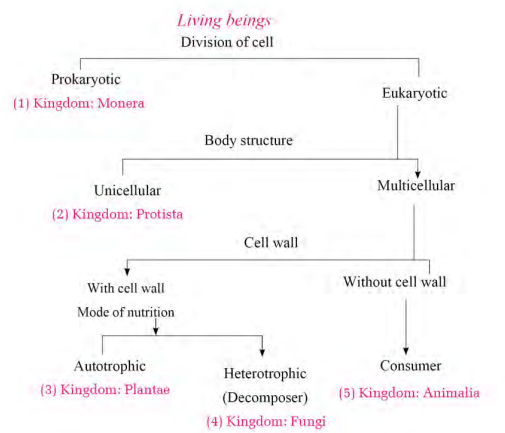
7. Five Kingdom System of Classification
Proposed by:
R. H. Whittaker (1969)
Why needed?
Two-kingdom system failed to:
Separate prokaryotes and eukaryotes
Separate unicellular and multicellular organisms
Distinguish fungi from plants properly
8. Basis of Five Kingdom Classification
Type of cell (Prokaryotic / Eukaryotic)
Body structure (Unicellular / Multicellular)
Presence of cell wall
Mode of nutrition
Role in ecosystem
9. Five Kingdoms and Their Characteristics
1️⃣ Kingdom Monera
Prokaryotic
No true nucleus
Unicellular
Can survive extreme conditions
Examples:
Bacteria
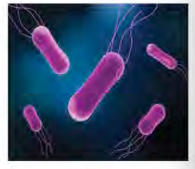
Cyanobacteria (Nostoc, Anabaena)
Types:
Archaebacteria
Eubacteria
Cyanobacteria
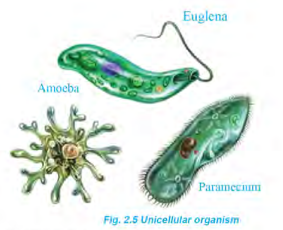
2️⃣ Kingdom Protista
Eukaryotic
Mostly unicellular
Locomotion by pseudopodia, cilia or flagella
Both sexual and asexual reproduction
Examples:
Amoeba
Euglena
Paramecium
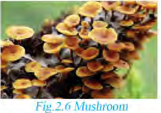
3️⃣ Kingdom Fungi
Eukaryotic
Mostly multicellular
No chlorophyll
Saprotrophic nutrition
Body made of mycelium
Examples:
Mushroom
Yeast
Mucor
Types of fungi:
Saprophytic
Parasitic
Symbiotic (Lichen)
4️⃣ Kingdom Plantae
Multicellular
Cell wall present
Autotrophic (photosynthesis)
Chlorophyll present
Examples:
Fern
Mustard
Mango

5️⃣ Kingdom Animalia
Multicellular
No cell wall
Heterotrophic
Consumers
Examples:
Human
Monkey
Fish

10. Importance of Fungi
Decomposition
Fermentation (Yeast)
Bakery and alcohol industry