1. Nature and Environment
There are many types of living and non-living things found in our surroundings.
Living beings include microorganisms, plants, animals, and human beings, whereas non-living components include air, water, soil, light, and heat.
The total composition of living and non-living things and their interaction is called the environment.
Living beings are directly or indirectly dependent on non-living components for survival.
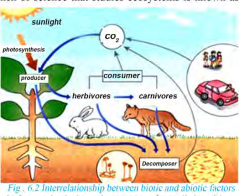
2. Ecosystem (6.1)
The continuous and permanent interrelationship between living beings and the physical environment is called an ecosystem.
The term ecosystem was first proposed by A.G. Tansley (1935 AD).
The branch of science that studies ecosystems is called Ecology.
Definition:
An ecosystem is a system formed by the interaction of biotic and abiotic components where energy and matter are continuously exchanged.
3. Components of Ecosystem
An ecosystem consists of two main components:
3.1 Abiotic Components
Abiotic components are non-living factors that affect organisms in the ecosystem.
(a) Air
Contains oxygen, nitrogen, carbon dioxide, and water vapour
Oxygen is used for respiration
Carbon dioxide is used in photosynthesis
Nitrogen helps in chlorophyll formation
Water vapour maintains humidity and water cycle
(b) Solar Energy
Main source of energy for all ecosystems
Required for photosynthesis
Controls climate, rainfall, temperature, and water cycle
Uneven distribution causes variation in plants and animals
Reason for fewer organisms in caves and deep seas:
Due to lack of sunlight and low temperature.
(c) Water
Essential for photosynthesis and metabolism
Required for growth and body functions
Present in body of plants and animals
Scarcity of water makes survival difficult
(d) Soil
Contains minerals like nitrogen, phosphorus, potassium
Provides habitat for organisms
Supplies water and nutrients to plants
Supports agriculture and settlement
4. Biotic Components
Biotic components include plants, animals, fungi, bacteria, and microorganisms.
They form a biotic community and are interrelated for:
Food
Shelter
Movement
Classification of Biotic Components:
Based on energy transfer, biotic components are divided into:
5. Producer
Producers are chlorophyll-containing organisms that prepare their own food.
Use solar energy for photosynthesis
Convert inorganic substances into organic food
Form the first trophic level
Examples:
Green plants, algae, phytoplankton, cyanobacteria
6. Consumer
Consumers are organisms that depend on producers or other organisms for food.
Types of Consumers:
(i) Primary Consumer
Herbivores
Feed directly on plants
Form second trophic level
Examples:
Grasshopper, rabbit, cow, deer, zooplankton
(ii) Secondary Consumer
Feed on primary consumers
Examples:
Frog, small fish, jackal, birds
(iii) Tertiary Consumer
Top-level carnivores
Examples:
Tiger, lion, crocodile, snake, large fish
7. Decomposer
Decomposers are microorganisms that break down dead plants and animals.
Convert dead matter into simple substances
Recycle nutrients back to soil
Clean the environment
Examples:
Bacteria, fungi
Hence, decomposers are called natural scavengers.
8. Types of Ecosystem
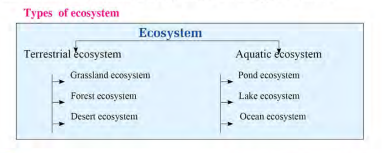
Ecosystem is mainly divided into two types:
8.1 Terrestrial Ecosystem
Ecosystem found on land.
Types:
Grassland ecosystem
Forest ecosystem
Desert ecosystem
Grassland Ecosystem
Formed by interaction of biotic and abiotic components in open land.
Abiotic Factors:
Air, soil, water, minerals, sunlight, humidity
Biotic Factors:
Producers: grasses, green plants
Primary consumers: insects, rabbits, deer
Secondary consumers: frogs, birds, jackals
Tertiary consumers: snake, tiger, lion
Decomposers: bacteria and fungi
8.2 Aquatic Ecosystem
Ecosystem formed in water bodies.
Types:
Pond ecosystem
Lake ecosystem
River ecosystem
Ocean ecosystem
Pond Ecosystem
Interaction between living and non-living components in a pond.
Abiotic Components:
Water, minerals, oxygen, carbon dioxide, light, soil
Biotic Components:
Producers: phytoplankton, algae, Hydrilla, Pistia
Primary consumers: zooplankton, tadpoles, small fish
Secondary consumers: frog, large fish
Tertiary consumers: snake
Decomposers: bacteria and fungi
9. Food Chain
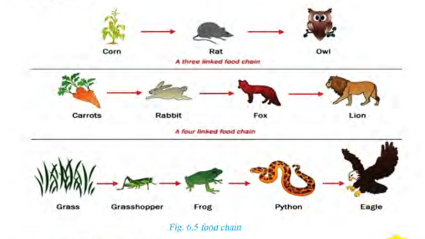
A food chain shows the linear transfer of energy from producer to top consumer.
Definition:
The linear sequence of eating and being eaten is called a food chain.
Example:
Grass → Grasshopper → Frog → Snake → Eagle
Trophic Levels:
Producer – First trophic level
Primary consumer – Second trophic level
Secondary consumer – Third trophic level
Tertiary consumer – Fourth trophic level
10. Food Web
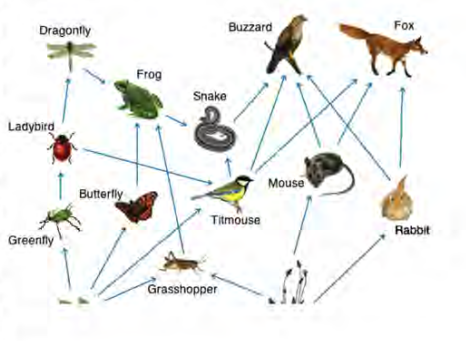
A food web is a network of interconnected food chains.
Provides multiple food sources
Increases ecosystem stability
Energy flows in multiple directions
11. Interaction Between Living Beings (6.2)
Living beings interact with each other for survival. These interactions are called biotic interactions.
Types of Biotic Interaction:
(i) Mutualism / Symbiosis
Both organisms are benefited.
Examples:
Lichens (algae + fungi)
Bird and flower
Human and intestinal bacteria
(ii) Commensalism
One organism is benefited; the other is neither benefited nor harmed.
Examples:
Heron and cow
Spider making web on tree
Barnacles on whale
(iii) Parasitism
One organism is benefited and the other is harmed.
Examples:
Tapeworm in intestine
Mosquito, flea, bed bug
Lice in human hair
(iv) Competition
Organisms compete for same resources like food and shelter.
Examples:
Wolf and bear competing for prey
Sea sponge and coral
(v) Predation
One organism kills and eats another organism.
Examples:
Tiger hunting deer
Owl hunting mouse
12. Importance of Balanced Ecosystem
Maintains environmental stability
Ensures continuous energy flow
Controls population
Keeps environment clean
Supports life on Earth