1. Introduction to Mushroom
What is a mushroom?
Mushrooms are a type of fungus that grow in soil, dung, tree barks, and moist places, especially during the rainy season.
Non-green in nature – They lack chlorophyll and cannot perform photosynthesis.
Mode of nutrition – Mushrooms are saprophytes (feed on dead and decaying organic matter).
2. Types of Mushrooms
Edible mushrooms – Safe for consumption.
Examples: Dalle, Parale, Kanye, Gobre, Kanne, Morchella (Guchi Chyau).
Poisonous mushrooms – Can cause illness or death.
Not all wild mushrooms are safe; some contain toxins.
3. Structure of Mushroom
The body has two main parts:
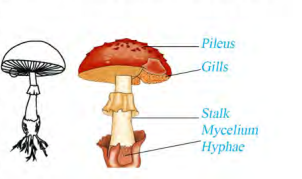
A. Mycelium – Vegetative part (under the soil)
Made of thread-like hyphae
Absorbs water and nutrients from organic matter
B. Fruiting body – Reproductive part (above ground)
Stipe – stalk
Pileus – umbrella-like cap
Gills – under the pileus, produce basidiospores
4. Life Cycle of Mushroom
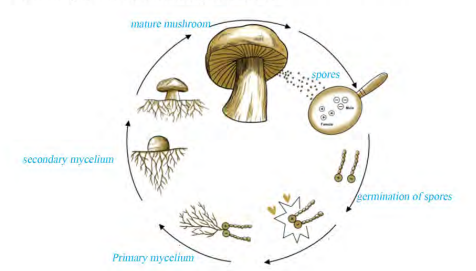
Basidiospores (haploid) are released from gills.
Spores germinate in favorable conditions → form primary mycelium (one nucleus).
Two opposite strain primary mycelia (+ and –) fuse → form secondary mycelium (dikaryotic – two nuclei).
Secondary mycelium grows and forms a small mushroom bud.
Bud matures into umbrella-shaped fruiting body.
Basidia in gills undergo meiosis to produce new basidiospores.
Cycle repeats.
5. Importance of Mushrooms
A. For Human Health
- Rich in protein (19–35% dry weight) – more than rice/wheat.
- Vitamins – B-complex (Riboflavin, Niacin, B12), especially important for vegetarians.
- Minerals – Potassium, phosphorus, iron, calcium, etc.
- Medicinal value – Boosts immunity, helps manage diabetes, blood pressure, cancer, respiratory diseases.
Example: Pycnoporus cinnabarinus used for asthma, diabetes.
B. Economic Importance
- Commercial farming – Source of income.
- Expensive varieties – Morchella (Guchi Chyau) sold internationally for >$500/kg.
- Processed products – Sukuti (dried), pickles, ketchup, soup.
- Major farmed types in Nepal:
- Kanne Chyau (Pleurotus) – Chaitra to Kartik
- Gobre Chyau (Agaricus bisporus) – Mountain regions
6. Mushroom Farming (Kanya Chyau in Hay)
Steps:
- Cut hay into 1–3 inch pieces.
- Boil for 15–20 mins to kill germs.
- Dry and keep in plastic bag for one day.
- Make 5–6 layers of hay in bag, sowing mushroom seeds between layers.
- Press layers, make 10–12 holes in bag.
- Keep in dark room for 7 days until white fibers (mycelium) appear.
- Make extra holes, sprinkle water as needed.
- Mushrooms appear in 10–17 days; mature in 25 days.
- Harvest by picking.
7. Storage and Use
Drying methods:
Sun drying – at >25°C
Chemical drying – using potassium bisulphite, citric acid, sugar, salt solution, then oven drying at 60–62°C
Products: Sukuti, pickle, ketchup, soup.
Making Sukuti:
Wash → cut → boil → dry (sun/fire/oven) → pack airtight → store.
8. Identifying Poisonous Mushrooms
- Warning signs (but not always accurate – lab test needed):
- Light gray color
- White gills
- Volva (cup-like structure) at stipe base
- Red stalk and cap
- Smooth pileus with no insect damage
- Yellow secretion when pressed
Never eat wild mushrooms unless identified by experts.
9. Key Terms
Hyphae – Thread-like structures forming mycelium
Mycelium – Vegetative network of hyphae
Basidiospore – Reproductive spore produced in gills
Saprophyte – Organism feeding on dead organic matter
Dikaryotic – Having two nuclei per cell