Introduction to Gases
- Suffocation in wells or breathlessness in caves is due to lack of oxygen and presence of certain gases.
- Gases like carbon dioxide (CO₂) and ammonia (NH₃) play significant roles in these phenomena.
- Refrigerators use ammonia gas because of its high solubility, cooling property, and low boiling point.
2. Carbon Dioxide (CO₂)
Sources of Carbon Dioxide
- Natural: Respiration of plants and animals, volcanic eruptions, decomposition of organic matter.
- Artificial: Deforestation, burning of fossil fuels (coal, wood, kerosene, oil, wax).
Discovery:
- Van Helmont (1630) discovered CO₂ by burning wood.
- Joseph Black (1755) prepared CO₂ by heating magnesium carbonate.
- Lavoisier proved it as a compound of carbon and oxygen.
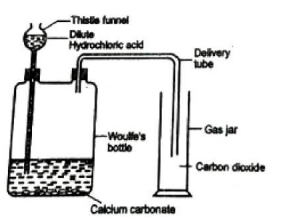
Laboratory Preparation of CO₂
Reaction:
CaCO3+2HCl→CaCl2+H2O+CO2
Apparatus & Chemicals:
- Woulfe’s bottle, gas jar, delivery tube, thistle funnel, rubber cork, limestone/marble powder, dilute HCl, lime water, phenolphthalein, blue litmus.
Procedure:
- Place limestone in Woulfe’s bottle.
- Pour dilute HCl through thistle funnel.
- Collect CO₂ in a gas jar by upward displacement of air.
Tests for CO₂:
- Extinguishes a burning matchstick.
- Turns moist blue litmus red.
- Lime water turns milky due to CaCO₃ formation:
Ca(OH)2+CO2→CaCO3+H2O
- Prolonged CO₂ passage makes it colorless due to Ca(HCO₃)₂ formation:
CaCO3+CO2+H2O→Ca(HCO3)2
Properties of CO₂
Physical:
- Colourless, odourless, slightly soluble in water, heavier than air (1.5×).
- Acidic, non-toxic but causes suffocation in high concentration.
- Forms dry ice at -78°C.
Chemical:
- Non-combustible and does not support combustion.
- Burns magnesium to form MgO and carbon:
2Mg+CO2→2MgO+C2
- Forms carbonic acid in water:
CO2+H2O→H2CO3
- Used in soft drinks, fire extinguishers, dry ice, sugar purification, urea, baking soda, carbogen, photosynthesis.
3. Ammonia (NH₃)
Sources of Ammonia
- Free state: Produced by decay of nitrogenous substances in absence of oxygen.
- Combined form: Found in ammonium chloride (NH₄Cl) and ammonium sulfate [(NH₄)₂SO₄].
Laboratory Preparation:
2NH4Cl+Ca(OH)2→CaCl2+2H2O+2NH3
Apparatus & Chemicals:
Hard glass test tube, lime tower, delivery tube, stand, ammonium chloride, calcium hydroxide.
Procedure:
Mix NH₄Cl and Ca(OH)₂ in a 2:1 ratio in test tube.
Heat gently, pass gas through lime tower to get pure dry ammonia.
Tests for NH₃:
Turns red litmus blue (basic gas).
Produces white fumes with concentrated HCl.
Properties of Ammonia
Physical:
Colourless, pungent odour, lighter than air, highly soluble in water, liquefies at -33.4°C, solidifies at -78°C.
Chemical:
Forms ammonium hydroxide in water:
NH3+H2O→NH4OH
Reacts with acids to form ammonium salts:
NH4OH+HCl→NH4Cl+H2O
Reacts with CO₂ at 1500°C under high pressure to form urea:
2NH3+CO2→NH2−CO−NH2+H2O
Burns in oxygen to form nitrogen and water.

Uses of Ammonia
Fertilizers: urea, ammonium sulfate, ammonium nitrate.
Manufacturing: nitric acid, washing soda, plastics, medicines.
Refrigerants, cleansing agent, blueprint production.
Activity: Construction of ammonia fountain demonstrates its high solubility and basic nature.
4. Greenhouse Effect
Natural Greenhouse: Earth’s atmosphere traps solar radiation through gases like CO₂, CH₄, N₂O, O₃, maintaining a habitable temperature.
Artificial Greenhouse: Transparent plastic/glass structures trap solar heat, useful for growing off-season plants.
Mechanism:
Short-wave radiation enters → absorbed by surfaces → converted to long-wave radiation → trapped → raises temperature.
Consequences of Enhanced Greenhouse Effect
Global temperature rise, climate change.
Melting glaciers, rising sea levels, flooding.
Loss of biodiversity, desertification, ecosystem imbalance.
Health impacts and decreased agricultural productivity.
Ways to Reduce Greenhouse Effect
Reduce CFCs and fossil fuel usage.
Promote renewable energy: solar, wind, hydroelectricity.
Plant more trees.
Reduce industrial CO₂ emissions.
5. Acid Rain
Formed when gases like SO₂, CO₂, NOx, Cl₂ mix with water vapor to produce acids: H₂SO₄, H₂CO₃, HNO₃, HCl.
pH of acid rain: 3–5 (normal rain ≈ 6).
Chemical Reactions:
SO2+H2O→H2SO3
CO2+H2O→H2CO3
Effects of Acid Rain
Erodes marble monuments and buildings.
Increases soil acidity → reduces crop productivity.
Pollutes water bodies → harms aquatic life.
Causes skin diseases and health issues.
Prevention
Reduce SO₂ and NOx emissions.
Promote renewable energy.
Raise awareness about acid rain.