1. Introduction
Force and motion are closely related. Motion occurs when an object changes its position with time. A force is required to start motion, stop motion, change speed, or change direction of motion. In daily life, we observe motion in vehicles, falling objects, running people, and moving machines.
2. Distance and Displacement
Distance
- Total length of the path covered by an object.
- Scalar quantity (has only magnitude).
- Always positive.
Displacement
- Shortest distance between initial and final position in a particular direction.
- Vector quantity (has magnitude and direction).
- Can be zero, positive, or negative.
3. Speed and Velocity
Speed
- Distance covered per unit time.
- Formula:
Speed = Distance / Time - Scalar quantity.
- SI unit: m/s
Velocity
- Displacement per unit time in a particular direction.
- Formula:
Velocity = Displacement / Time - Vector quantity.
- Can be positive or negative.
- Speed remains same if direction changes, but velocity changes.
4. Uniform and Non-uniform Motion
Uniform Motion
- Object covers equal distances in equal intervals of time.
- Speed or velocity remains constant.
Non-uniform Motion
- Object covers unequal distances in equal intervals of time.
- Speed or velocity changes.
5. Acceleration
Acceleration is the rate of change of velocity per unit time.
Formula:

Where,
u = initial velocity
v = final velocity
t = time
SI unit: m/s²
Acceleration due to gravity (g) = 9.8 m/s²
Retardation
- Decrease in velocity per unit time.
- Also called negative acceleration.
6. Equations of Motion
For motion in a straight line with uniform acceleration:
- v = u + at
- v² = u² + 2as
- s = ut + ½at²
These equations are used to solve numerical problems.
7. Graphs of Motion
(a) Displacement–Time Graph
- Slope represents velocity.
- Straight line → uniform velocity
- Horizontal line → object at rest
- Curved line → variable velocity
(b) Velocity–Time Graph
- Slope represents acceleration.
- Area under graph = displacement
- Horizontal line → uniform velocity
- Straight sloping line → uniform acceleration
8. Inertia
Inertia is the tendency of an object to resist any change in its state of rest or motion.
Types of Inertia
Inertia of Rest
- Object at rest remains at rest.
Example: Passengers fall backward when a bus starts suddenly.
Inertia of Motion
- Moving object continues moving.
Example: Passengers jerk forward when brakes are applied.
Inertia depends on mass.
More mass → more inertia.
9. Newton’s Laws of Motion
First Law (Law of Inertia)
An object remains at rest or in uniform motion unless an unbalanced force acts on it.
Second Law
Acceleration produced is:
- Directly proportional to force
- Inversely proportional to mass
F=ma

Where,
F = force, m = mass, a = acceleration
Third Law
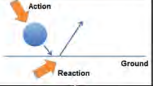
For every action, there is an equal and opposite reaction.
Examples:
- Walking
- Swimming
- Rocket launching
- Recoil of gun

10. Elasticity and Plasticity
Elasticity
- Property of a material to regain original shape after removing force.
- Example: Rubber band, spring
Plasticity
- Property of a material to retain deformed shape.
- Example: Clay, dough