1. Introduction
Matter: Anything that has mass and occupies space.
Classification of Matter:
Pure substances: Elements and compounds.
Impure substances: Mixtures.
Elements: Substances that cannot be broken down into simpler substances by chemical methods.
Total known elements: 118.
Elements are classified as:
Metals: Usually shiny, malleable, ductile, good conductors of heat and electricity.
Non-Metals: Dull, brittle, poor conductors of heat and electricity.
Metalloids: Have properties of both metals and non-metals.
2. Minerals
Definition: Naturally occurring inorganic, solid, crystalline substances with a definite chemical composition.
Source of metals: Most metals are obtained from minerals.
Examples: Hematite (Fe₂O₃), Malachite [Cu₂(OH)₂CO₃], Bauxite (Al₂O₃·2H₂O), Talc, Limestone, Granite, Coal.
Properties of minerals:
- Inorganic
- Solid
- Crystalline
- Fixed chemical formula
Note: Non-reactive metals like gold and silver can be found in pure state, whereas reactive metals like sodium, potassium, calcium, and iron are found in compound form.
3. Ores
Definition: A mineral from which a metal can be extracted economically and easily.
Difference between mineral and ore:
All ores are minerals, but not all minerals are ores.
Examples of Ores
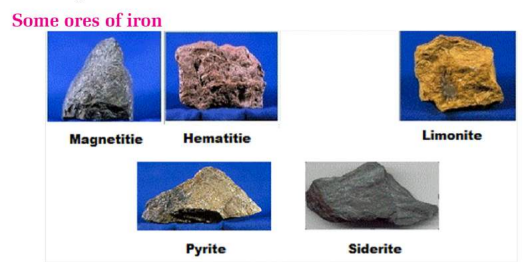
Iron ores: Hematite (Fe₂O₃ – chief ore), Magnetite (Fe₃O₄), Limonite (2Fe₂O₃·3H₂O), Siderite (FeCO₃), Pyrite (FeS)
Aluminium ores: Bauxite (2Al₂O₃·2H₂O – chief ore), Cryolite (Na₃AlF₆), Corundum (Al₂O₃)
Copper ores: Chalcocite (Cu₂S), Chalcopyrite (CuFeS₂ – chief ore), Cuprite (Cu₂O), Malachite [Cu₂(OH)₂CO₃]
Silver ores: Argentite (Ag₂S – chief ore), Horn silver (AgCl), Ruby silver (Ag₃SbS₃), Silver copper glance (Ag(Cu)₂S)
Gold: Found in pure state or in alluvial soil.
4. Metallurgy
Definition: The branch of science that deals with extraction, properties, purification, and production of metals.
Steps in Metallurgy:
Step 1: Mining
Definition: Process of extracting ores and minerals from the earth's crust.
Metals like coal, petroleum, gold, and metallic ores are obtained through mining.
Step 2: Grinding
Definition: Crushing ores into small particles to facilitate separation of impurities.
Step 3: Concentration (Purification of Ore)
Definition: Removal of impurities (gangue) to increase the metal content.
Methods:
Gravity or Hydraulic separation – based on density differences.
Magnetic separation – magnetic vs. non-magnetic substances.
Froth flotation – hydrophilic vs. hydrophobic differences.
Activity example: Separating iron dust from sand and aluminum using a magnet.
Step 4: Oxidation
Definition: Conversion of ores into metal oxides for easier extraction.
Types:
Roasting: Heating sulfide ores in presence of oxygen.
Example: ZnS → ZnO + SO₂
Calcination: Heating carbonate ores in absence of oxygen.
Example: CaCO₃ → CaO + CO₂
Step 5: Reduction
Definition: Removing oxygen from metal oxides to obtain metals.
Methods:
Using carbon, CO, or hydrogen.
Reactive metals (Na, K, Ca, Al) need electrolysis.
Example reactions:
CuO + C → Cu + CO
ZnO + C → Zn + CO
Step 6: Smelting
Definition: Heating metal oxides with reducing agents above melting point to obtain molten metal and remove impurities as slag.
Step 7: Refining
Definition: Purifying metals obtained from reduction.
Methods:
Distillation – for metals with low boiling points (e.g., Mercury).
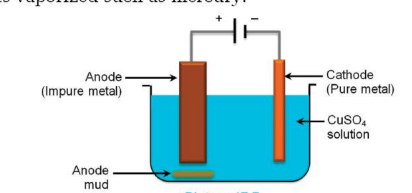
Electro-refining – uses electrolysis:
Impure metal → anode
Pure metal → cathode
Electrolyte → metal salt solution (e.g., CuSO₄ for copper)
Example: Electro-refining of copper deposits pure copper on cathode.
5. Key Terms
Gangue: Impurities present in ores.
Ore: Mineral from which metal can be extracted economically.
Mineral: Naturally occurring solid substance with fixed composition.
Roasting: Heating sulfide ores in presence of oxygen.
Calcination: Heating carbonate ores in absence of oxygen.
Smelting: Extraction of metal from oxide ore above melting point.
Refining: Purification of metals.
6. Examples of Common Metals and Their Ores
MetalOre% Metal in OreTypeIronHematite, Magnetite75% (Hematite)ReactiveAluminiumBauxite, Cryolite40–60% (Bauxite)ReactiveCopperChalcopyrite, Malachite34–57%ReactiveSilverArgentite, Horn silver87% (Argentite)Non-reactiveGoldNative gold99–100%Non-reactive7. Summary
Metals are mostly reactive and found in ores; non-metals may be found pure.
Metallurgy involves: Mining → Grinding → Concentration → Oxidation → Reduction → Smelting → Refining.
Metals like Fe, Cu, Al, Ag, Au are obtained through specific ores and processes.
Key Points: Minerals, ores, gangue, roasting, calcination, smelting, refining.