1. Introduction to Pressure
Imagine placing a brick on a soft foam. The brick squishes the foam because it pushes on a small area with its whole weight. That push per unit area is called pressure. Everything around you solids, liquids, gases applies pressure.
Definition of Pressure
Pressure is thrust (force acting perpendicular to a surface) per unit area.
Pressure=ForceArea\text{Pressure} = \frac{\text{Force}}{\text{Area}}Pressure=AreaForce
SI unit: Pascal (Pa) or N/m².
Why pressure matters
Solids exert pressure on the surface below them.
Liquids exert pressure on the walls and bottom of their container.
Gases exert pressure on anything they touch (like the air pushing on a postcard).
2. Pressure in Solids, Liquids, and Gases
Pressure by solids
When a brick sits on foam, its weight pushes down, creating pressure. More weight or smaller area = more pressure.
Pressure by liquids
Liquids exert pressure in all directions, not just downward.
Example: A pipe bursts because water pushes outward on its walls.
Pressure by gases
Gases also press on surfaces.
Example: Air pushes a postcard upward when the wind flows under it.
3. Fluids and Their Behavior
Liquids and gases are called fluids because they flow.
Fluids always exert pressure on:
- bottom
- walls
- any object placed inside them
Experiment example: A balloon placed underwater is pushed upward by water pressure.
4. Transmission of Pressure in Fluids
Why solids don’t transmit pressure
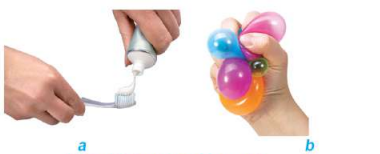
In solids, molecules are tightly packed. If you press one side, only that part feels pressure.
Why liquids and gases do
Their molecules can move.
Pressure applied at one point in a closed fluid spreads equally through the entire fluid.
Syringe experiment
- Syringe with water: Hard to compress.
- Syringe with air: Easy to compress at first because gases have more space between molecules.
Important point
Liquids are nearly incompressible, so they transmit pressure very effectively.
Gases need to be compressed first to transmit pressure similarly.
5. Pascal’s Law
Pascal’s Law Definition
When pressure is applied at one point in an enclosed liquid, it is transmitted equally in all directions.
Verification Diagram Explanation
A vessel has four pistons A, B, C, D of different sizes.
Push piston A → All other pistons move outward.
This proves the same pressure is transmitted everywhere.
Formula
F1/A1=F2/A2
Where:
F1: Force on small piston
A1: Area of small piston
F2: Output force
A2: Area of large piston
Larger the area A2, larger the force F2.
6. Hydraulic Machines
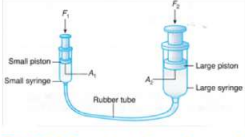
Hydraulic machines work using Pascal’s law.
They magnify a small force into a large force.
Basic Structure
- Two pistons connected by a pipe
- Filled with a non-compressible fluid (oil/water)
- Small piston = input
- Big piston = output
Hydraulic Machine Formula
F2=f1*A2/A1
Force multiplies because area of big piston is larger.
Examples of Hydraulic Machines
1. Hydraulic Lift
Used in:
- Dentists' chairs
- Car repair workshops
A small push on the pedal applies pressure to fluid → Big piston lifts heavy weight.
2. Hydraulic Brake System
Used in cars and bikes.
Pressing the brake pedal applies pressure to brake fluid → Large force presses brake pads → vehicle stops.
3. Hydraulic Jack
Used to lift cars. Pushing the lever repeatedly pumps oil under the lifting piston.
4. Hydraulic Press
Used to:
- press metal
- compress materials
- fit machine parts
- punch holes
7. Upthrust (Buoyant Force)
Definition
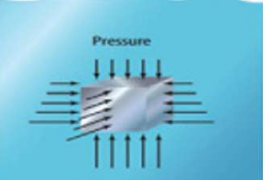
Upthrust is the upward force a fluid applies on an object immersed in it.
SI unit: Newton (N)
Reason for Upthrust
Pressure increases with depth.
Bottom of object has higher pressure than top → Net upward force.
Examples
- Empty bottle floats because upthrust > weight
- Bottle filled with water sinks because weight > upthrust
- Bucket in well feels lighter inside water because upthrust reduces apparent weight
- Airplane experiences upthrust from air
Real Weight & Apparent Weight
Weight in air = real weight
Weight in water = apparent weight
Upthrust = real weight minus apparent weight
Differences
Pressure in Solids vs Liquids vs Gases
PropertySolidsLiquidsGasesMolecule structureVery closeLess closeVery farPressure directionOnly downwardAll directionsAll directionsCompressibleNoAlmost noYesPressure transmissionNoYesYes (after compression)Hydraulic Machines vs Normal Machines
Hydraulic MachineNormal MachineUses liquidsUses mechanical partsBased on Pascal’s lawBased on mechanical advantageMultiplies force easilyMultiplies force limitedlyGallery
Transmission of Pressure in Fluid
Transmission of Pressure in Fluid
Hydraulic Machine
Hydraulic Machine
Direction of upthrust
Direction of upthrust