Scientific Learning
Scientific study is basically humanity’s attempt to stop guessing and start knowing. Instead of relying on random assumptions, science observes the world in an organized, logical way. It uses facts, theories, models, experiments and measurable evidence to understand why things happen the way they do. Every natural event has causes behind it, and science tries to uncover those causes through systematic investigation.
A key part of scientific study is identifying what factors influence a phenomenon. These factors, which can change the outcome of an event, are called variables. Understanding variables helps scientists explain how one change leads to another. Once these relationships are known, humans can predict results more accurately and solve problems more effectively.
1.1 Variables in Scientific Research
Whenever something in nature changes, humans get curious about why it happened. This curiosity leads to investigation, and investigation depends on understanding variables. A variable is simply any physical quantity or factor that can change. Recognizing variables makes it possible to figure out cause and effect.
Consider a wilted plant. You might wonder whether it wilted because it lacked water, received too much sunlight, or had some other issue. These “possible reasons” are variables, and the plant’s wilting is the effect.
In scientific experiments, researchers purposely change one variable and observe how another variable responds. For example, when stretching a rubber band to shoot a paper bullet, increasing the stretching increases how far the bullet travels. Both stretching and distance are variables because they change every time you repeat the experiment.
To make scientific results meaningful, variables are classified into three types:
Independent Variable
This is the variable the researcher intentionally changes. It is the cause in a cause-effect relationship.
In the rubber band example, the amount of stretch is the independent variable because the experimenter controls it.
Dependent Variable
This variable changes as a result of the independent variable. It is the effect.
In the catapult experiment, the distance travelled by the bullet is the dependent variable, because it depends on how much the rubber band is stretched.
Controlled Variables
These are all other variables that could affect the results. They must be kept constant so they don’t interfere.
For the rubber band experiment, the thickness of the rubber band and the size of the paper bullet must stay the same throughout.
Scientific research becomes unreliable if too many variables are changing at once. Proper experiments control all unnecessary variables so that the relationship between independent and dependent variables becomes clear and trustworthy.
1.2 Units and Measurement
Introduction
Science involves measuring things. You cannot understand physical quantities like length, time, mass or force unless you measure them in standard units. Units help communicate measurements clearly and avoid confusion. All physical quantities use either fundamental units or derived units.
Fundamental Units
A fundamental unit is a basic unit that does not depend on any other unit. It stands on its own.
For example, metre (m), kilogram (kg), and second (s) exist independently.
The SI system has seven fundamental units:
- metre (length)
- kilogram (mass)
- second (time)
- kelvin (temperature)
- candela (luminous intensity)
- ampere (electric current)
- mole (amount of substance)
Derived Units
Derived units are combinations of fundamental units. They don’t have independent existence.
For example:
- velocity = m/s
- density = kg/m³
- force = kg m/s² which we simply call newton (N)
- pressure = N/m² which is pascal (Pa)
- work = joule (J)
- power = watt (W)
Some derived units get special names (like newton or joule), while others remain in combined form (like kg/m³)
Unit Analysis (Dimensional Analysis)
Scientists check if an equation is valid by comparing the units on both sides.
For an equation to be correct, its units must match.
Example:
s = v × t
Left side: metre
Right side: (m/s × s) = metre
Units match, so the equation is valid.
But if someone claims:
s = v/t
Right side becomes m/s² which does not match metre. Therefore, the equation is invalid.
Addition and subtraction also require identical units. You can add ms⁻¹ + ms⁻¹ but not m + ms⁻¹.
Unit analysis is used to verify equations, check relationships between quantities, and convert units.
Summary
Scientific study is a systematic approach to understanding natural events by using observation, evidence, and logical analysis. Every natural event is influenced by factors called variables, which help researchers determine cause and effect. Variables are classified into independent, dependent, and controlled variables. Independent variables are deliberately changed, dependent variables respond to those changes, and controlled variables remain constant to ensure reliable results.
Measurement is another essential part of science, and it is handled through units. Physical quantities use either fundamental units, which are basic and independent, or derived units, which are combinations of fundamental units. Dimensional or unit analysis helps verify whether scientific equations are correct by comparing the units on both sides. This ensures clarity, consistency and accuracy in scientific work.
Gallery
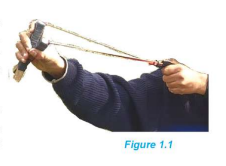
Making catapult from a rubber band
Making catapult from a rubber band