Introduction to the Universe
Definition
The universe is the vast area around us containing all celestial bodies, space, matter, and energy that exists.
Celestial Bodies in the Universe
The universe contains various types of celestial bodies:
- Stars: Self-luminous celestial bodies
- Planets: Non-luminous bodies revolving around stars
- Satellites: Natural bodies revolving around planets
- Comets: Icy bodies with tails when near the sun
- Meteors: Small bodies that burn up in atmosphere ("shooting stars")
- Meteorites: Meteors that reach Earth's surface
- Asteroids: Rocky bodies, smaller than planets (baby planets)
- Galaxies: Groups of many stars held together
States of Matter in Space
- Some celestial bodies are in gaseous state
- Others are in solid state
- Mass varies from very large to very small
The Milky Way Galaxy
- Our Solar System is located in the Milky Way galaxy
- A galaxy is a group of many stars
- Distance from center: About 30,000 light years
- Diameter: About 100,000 light years
- Estimated stars: About 1.5 billion stars
Current Understanding
- Science has not yet obtained concrete information about:
- The exact size of the universe
- The complete origin of the universe
- The total spread of the universe
- The universe is continuously being studied and explored
12.1 Importance of Gravitational Force in the Universe
What is Gravitational Force?
Definition: The mutual force of attraction between all celestial bodies in space is called gravitational force.
How Gravitational Force Works
Mutual Attraction:
- Sun attracts Earth toward its center
- Earth attracts Sun toward its center
- Earth attracts Moon toward its center
- Moon attracts Earth toward its center
- Every celestial body attracts every other celestial body
Key Roles of Gravitational Force
- Holds celestial bodies in position
- Prevents planets from floating away
- Maintains structure of the universe
- Causes Earth's motion
- Earth rotates on its axis
- Earth revolves in its orbit around the Sun
- Causes Moon's revolution
- Moon revolves around Earth
- Maintains planetary orbits
- Every celestial body in the solar system revolves around the Sun
- Planets maintain alignment in their orbits
- Prevents collisions between planets and satellites
- Explains everyday phenomena
- When a ball is thrown upward, it falls back to Earth
- Objects always fall toward Earth's surface
Why Objects Fall to Earth
- Earth has mass, therefore it has gravity
- Earth's gravitational force pulls all objects toward its center
- This is why thrown objects return to the ground
12.2 Study of the Universe
Universe Science (Cosmology)
Definition: The branch of science that studies various facts about the universe including:
- History of the universe
- Origin of the universe
- Future of the universe
- Structure and composition
Astrophysics: A branch that specifically studies:
- Origin of the universe
- Structure of the universe
- Future of the universe
The Big Bang Theory
Overview
The Big Bang Theory is considered the most reliable theory about the origin of the universe.
Evidence for the Theory
The theory is based on the observation that:
- All galaxies, including the Milky Way, are moving away from each other
- They are moving at tremendous speed
- The universe is expanding
The Four Fundamental Forces
Before the Big Bang, four forces were unified as a single force:
- Gravitational force
- Electromagnetism
- Strong nuclear force
- Weak nuclear force
State Before the Big Bang
Initial Conditions:
- Universe was in a very compressed state
- Extremely small - size of a single atom
- Extremely dense - all mass concentrated
- Very energetic state
- Under excessive force and pressure
The Big Bang Explosion
What Happened:
- Due to excessive force and pressure, a huge explosion occurred
- The single dense atom exploded
- The universe originated from this explosion
- All celestial bodies originated from this explosion
After the Explosion
Expansion Process:
- Like particles scattering in an explosion, all celestial bodies moved away from each other
- The size of the universe is increasing day by day
- Expansion is slow but continuous
- However, the speed is decreasing due to gravitational force
Balloon Analogy (Activity 12.3)
Demonstration:
- Take a balloon and blow a little air into it
- Mark dots of different colors on the surface
- Gradually inflate the balloon
- Observe: As balloon size increases, distance between dots increases
- Conclusion: Similarly, as universe expands, galaxies move apart
Hubble's Study
Edwin Hubble's Discovery (1929)
Observation:
- American astronomer Edwin Hubble used the 100-inch Hooker telescope on Mount Wilson
- Calculated velocities of various galaxies
- Discovered that every galaxy is moving away from other galaxies
Key Findings
- Distance-Appearance Relationship:
- Farther celestial bodies appear smaller
- They also have greater velocity
- Distance-Velocity Relationship:
- The farther the galaxies, the faster they are separating
- Direct relationship between distance and velocity
Hubble's Law
Equation:
v=H×dv = H \times dv=H×d
Where:
- v = velocity with which galaxies are moving away from each other
- d = distance between galaxies
- H = Hubble's constant
Hubble's Constant (H):
- Value: 73 km/s/Mpc
- Units: Kilometer per second per Mega parsec
- Meaning: If two galaxies are 1 megaparsec apart, they separate at 73 km/s
Graph Representation
- X-axis: Distance (Mpc)
- Y-axis: Recessional Velocity (km/s)
- Shows linear relationship between distance and velocity
Significance of Hubble's Study
- Confirms universe is expanding
- Size of the universe is increasing
- Galaxies are moving away from each other
- Supports Big Bang Theory
- If galaxies are moving apart now, they were closer in the past
- Going back in time, they were all at the same point
- This single point is where the Big Bang occurred
- Provides quantitative data
- Can calculate velocities of galaxies
- Can estimate distances in the universe
12.3 Future of the Universe
The Central Question
All galaxies are moving away from each other, BUT:
- Gravitational force is pulling them back together
- As they move apart, their velocity decreases (due to gravity)
- As distance increases, gravitational effect decreases
Critical Question: Which becomes zero first?
- Does velocity become zero before gravity effect?
- Does gravity effect become zero before velocity?
- Do both become zero at the same time?
Answer determines the future of the universe
Rocket Analogy (Activity 12.4)
Scenario: A rocket launched from Earth
- Initial speed moves rocket away from Earth
- Gravity decreases the rocket's speed
- But gravity also weakens with distance
Three Possibilities:
- Gravity becomes zero before speed → Rocket escapes forever
- Speed becomes zero before gravity → Rocket falls back
- Both become zero together → Rocket stays at that position
Understanding Critical Density
Newton's Universal Law of Gravitation:
- Every mass exerts gravitational force on every other mass
- Force is directly proportional to product of masses
- Force is inversely proportional to square of distance
Key Concepts:
- Net gravitational force depends on:
- Total mass in the universe
- Volume of the universe
- Density = Mass ÷ Volume
- Net gravity depends on average density of universe
Critical Density:
- The average density required to stop the expanding universe
- This would happen after billions of years
- Determines which of the three futures will occur
Three Possible Futures of the Universe
(a) Open Universe
Condition: Average density < Critical density
What Happens:
- Celestial bodies retain some velocity when gravity becomes zero
- They continue to move away from each other forever
- Size of the universe continues to increase indefinitely
- Gravity cannot hold the expanding process
- Universe expands eternally
Characteristics:
- Continuous expansion
- Never stops expanding
- Never collapses
- Galaxies separate forever
Graph: Continuously rising curve showing endless expansion
(b) Flat Universe
Condition: Average density = Critical density
What Happens:
- Gravity and velocity become zero at the same time
- Celestial bodies remain in the same position after that
- Universe becomes stable
- Expansion rate gradually decreases and finally stops
Final State:
- Infinite distance between celestial bodies
- No mutual gravitational force effect
- Universe remains static
- Neither expanding nor contracting
Characteristics:
- Balanced state
- Expansion stops eventually
- Stable equilibrium
- No further change
Graph: Curve that levels off to horizontal line
(c) Closed Universe
Condition: Average density > Critical density
What Happens:
- Gravitational effect remains when speed becomes zero
- Celestial bodies start to come closer
- Universe begins to contract
- Eventually shrinks to a single point
The Big Crunch:
- The phenomenon where the vast universe collapses
- All unlimited mass and energy compress to one point
- Universe "crunches" back to its starting point
- Similar to Big Bang in reverse
Life Cycle of the Universe:
- Big Bang → Universe expands
- Expansion slows and stops
- Contraction begins
- Big Crunch → Universe collapses to a point
- New Big Bang → New universe forms
- Cycle repeats indefinitely
Characteristics:
- Universe has a fixed age
- Has a life cycle (like stars)
- Big Bang and Big Crunch appear in turn
- Cyclical nature - repeats forever
Graph: Curve that rises then falls back down
Comparison of Three Universe Types
FeatureOpen UniverseFlat UniverseClosed UniverseDensityLess than criticalEqual to criticalGreater than criticalExpansionContinues foreverStops eventuallyReverses to contractionFinal StateInfinite sizeStable, very largeCollapses to a pointGravity EffectToo weak to stopJust enough to stopStrong enough to reverseTime ScaleEternal expansionExpansion stops after infinite timeHas life cycleShape on GraphContinuously risingLevels off horizontallyRises then falls
Determining the Future
Main Determining Factor
Gravitational Force determines which future will occur
Gravity depends on:
- Mass of the universe
- Size (volume) of the universe
- Density (mass ÷ volume) of the universe
Current Estimation Method
How we estimate density:
- Based on masses seen in space
- Observation of visible celestial bodies
- Calculation of their masses and distances
Uncertainty
Question: Can the actual density be determined in the future?
Challenge:
- Much of the universe may be invisible
- Dark matter and dark energy exist but are hard to measure
- Our observations are limited by technology
- The universe is vast and mostly unexplored
Summary of Key Concepts
The Universe
- Vast region containing all celestial bodies
- Includes stars, planets, satellites, comets, meteors, asteroids
- Galaxies are groups of stars
- Milky Way contains ~1.5 billion stars
Gravitational Force
- Mutual attraction between all celestial bodies
- Holds universe together
- Causes orbital motion
- Prevents collisions
- Makes objects fall to Earth
Big Bang Theory
- Most reliable theory of universe origin
- Universe began from explosion of single dense atom
- All celestial bodies originated from this explosion
- Universe has been expanding since then
- Expansion is slowing due to gravity
Hubble's Discovery
- All galaxies moving away from each other
- Farther galaxies move faster
- Relationship: v = Hd
- Confirms expanding universe
- Supports Big Bang Theory
Future of Universe
Three possibilities depend on average density:
- Open: Expands forever (density < critical)
- Flat: Expansion stops, becomes stable (density = critical)
- Closed: Collapses back, cycles repeat (density > critical)
Important Terms
- Universe: All space, matter, and energy that exists
- Galaxy: Group of many stars held together by gravity
- Gravitational Force: Mutual attraction between masses
- Big Bang: Huge explosion that created the universe
- Expansion: Universe getting larger over time
- Hubble's Law: v = Hd (relates galaxy velocity and distance)
- Critical Density: Density needed to stop expansion
- Open Universe: Expands forever
- Flat Universe: Expansion stops, becomes stable
- Closed Universe: Expands then contracts
- Big Crunch: Universe collapsing to a single point
- Light Year: Distance light travels in one year
- Parsec: Unit of astronomical distance
Gallery
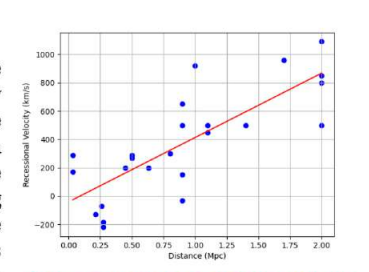
Hubble's relation between velocity and distance
Hubble's relation between velocity and distance
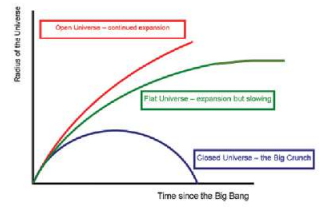
Types of Universe
Types of Universe
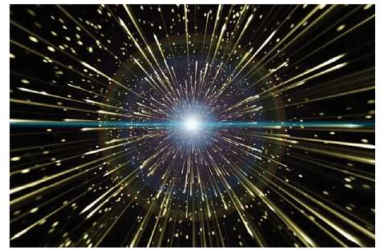
Huge explosion of atom
Huge explosion of atom

Gravitational force
Gravitational force