Chapter 10: Wave - Light
Introduction to Light Phenomena
Light exhibits various behaviors when passing through different media:
- Refraction: Pencil appears bent when partially dipped in water due to different speeds of light in water and air
- Total Internal Reflection: Air bubbles shine in water like mirrors; principle used in optical fibers
- Magnification: Letters appear enlarged through hand lens due to special glass structure
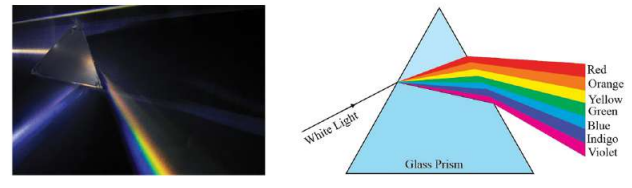
- Dispersion: Rainbow formation - sunlight splits into seven constituent colors
Denser and Rarer Medium
Definition
Transparent Medium: Substance through which light propagates (air, glass, water)
Speed of Light in Different Media
Mediumspeed of light(m/s)Air3.00 × 10⁸Water2.25 × 10⁸Alcohol2.19 × 10⁸Kerosene oil2.08 × 10⁸Glass2.00 × 10⁸Diamond1.24 × 10⁸Key Concepts
- Denser Medium: Medium where speed of light is less (e.g., glass compared to air)
- Rarer Medium: Medium where speed of light is more (e.g., air compared to glass)
Important Note: Optically denser does NOT mean physically denser. Kerosene oil floats on water (less physical density) but light travels slower in kerosene than water (higher optical density).
Refraction of Light
Definition
Refraction: The process of bending or changing direction of light while passing from one optical medium to another due to change in speed.
Key Observations
- Light traveling from air to water: Bends towards the normal (speed decreases)
- Light traveling from water to air: Bends away from the normal (speed increases)
Important Terminologies
- Normal: Imaginary line perpendicular to the interface of two media
- Incident Ray: Ray from the source of light before refraction
- Angle of Incidence (i): Angle made by incident ray with the normal
- Refracted Ray: Ray which bends at the border and enters the second medium
- Angle of Refraction (r): Angle made by refracted ray with the normal
- Emergent Ray: Ray which comes out of the object into the first medium after refraction
- Angle of Emergence (e): Angle made by emergent ray with the normal
- Lateral Shift: Perpendicular distance between emergent ray and the line formed when refracted ray is produced
Refraction Through Glass Slab
When light passes through a rectangular glass slab:
- Light bends towards the normal when entering glass (air to glass)
- Light bends away from the normal when exiting glass (glass to air)
- Angle of incidence (i) = Angle of emergence (e)
- Lateral shift occurs due to bending inside the glass slab
Laws of Refraction of Light
Snell's Law
First Law: The incident ray, normal, and refracted ray all lie on the same plane at the point of incidence.
Second Law: The ratio of sine of angle of incidence to sine of angle of refraction remains constant for a pair of media.
Mathematical Expression:
sin i / sin r = constant (μ)
Where μ (mu) is the refractive index of the medium.
Refractive Index
Formula:
μ = speed of light in air or vacuum (c) / speed of light in the medium (v) μ = c / v
MediumRefractive IndexSpeed of Light (m/s)water1.332.25 × 10⁸Alcohol1.362.19 × 10⁸Kerosene oil1.442.08 × 10Glycerin1.472.04 × 10⁸Glass1.502.00 × 10⁸Diamond2.421.24 × 10⁸Observation: As refractive index increases, speed of light in medium decreases.
Consequences of Refraction of Light
1. Water-Air Interface Effects
- Objects partially dipped in water appear bent
- Depth of objects in water appears less than actual depth
- Coin at bottom of beaker becomes visible when water is poured (appears closer)
2. Atmospheric Refraction
Twinkling of Stars:
- Light from stars undergoes successive refractions through different atmospheric layers
- Different layers have different refractive indices and keep changing position
- Causes changes in brightness and position of stars
- Planets don't twinkle because they're closer and appear bigger
Advanced Sunrise and Delayed Sunset:
- Sun appears above horizon even when actually below it
- Atmospheric refraction causes light to bend towards normal
- Sun visible 2 minutes before actual sunrise and 2 minutes after actual sunset
Total Internal Reflection of Light
Critical Angle
Definition: The angle of incidence in denser medium for which the angle of refraction in rarer medium becomes 90°.
Conditions:
- Light passes from denser to rarer medium
- Angle of refraction increases with angle of incidence
- Maximum angle of refraction = 90°
Total Internal Reflection
Definition: Phenomenon of reflecting light to the same medium when it passes from denser to rarer medium with angle of incidence greater than critical angle.
Necessary Conditions:
- Light must travel from denser to rarer medium
- Angle of incidence must be greater than critical angle
Note: In total internal reflection, ALL light is reflected (not partial like normal reflection).
Applications of Total Internal Reflection
1. Prisms
- Equilateral triangular prism: Can reflect light through 60°
- Right-angled triangular prism: Can reflect light through 90° and 180°
- Used in periscopes, SLR cameras, and binoculars
- Advantage: No loss of light intensity (complete reflection)
2. Sparkling of Diamond
- High refractive index (2.42) gives small critical angle (24°)
- Cut with multiple faces for maximum internal reflections
- Light undergoes multiple total internal reflections
- Creates brilliant sparkle effect
3. Shining Surfaces
- Air bubbles in water: Total internal reflection at water-air interface
- Empty test tube in water: Glass-air interface appears shiny when viewed at angle
4. Mirage
- Illusion of water on hot roads in summer
- Hot surface creates air layers of different temperatures
- Hot air = rarer medium, cool air = denser medium
- Light undergoes continuous refraction, then total internal reflection
- Inverted image appears to flicker like water surface
5. Sound Wave Refraction
- Daytime: Sound waves bend upward, harder to hear at distance
- Nighttime: Sound waves bend downward due to total internal reflection, can hear clearly even at distance
Optical Fiber
Structure
- Core: Bundle of thin transparent glass/plastic fibers
- Cladding: Surrounding layer with lower refractive index than core
- Plastic Coating: Outer protective layer
Working Principle
- Light enters fiber at angle greater than critical angle
- Undergoes continuous total internal reflection in core
- Light travels through fiber regardless of whether straight or bent
- Emerges from other end without loss
Applications
1. Telecommunications:
- Rapid transmission of signals/data as light waves
- Data transmission rate: 1 Gigabyte per second (1 Gbps)
- Can transmit thousands of telephone calls simultaneously
- High-speed internet, HD video streaming
- Cables laid on ground, in air, and under sea
2. Medical Field:
Endoscopy:
- Nonsurgical examination of internal organs
- Two parallel fiber bundles: one carries light in, other collects reflected light
- Used to diagnose digestive system (esophagus, stomach, small intestine)
Colonoscopy:
- Type of endoscope for examining colon and large intestine
- Inserted through rectum
Keyhole Surgery (Laparoscopic Surgery):
- Small incision in skin for surgery
- Laparoscope with fiber bundles and camera
- Used to remove organs, take tissue samples, remove stones
Dispersion of Light
Definition
Dispersion: Process where light splits into seven constituent colors (red, orange, yellow, green, blue, indigo, violet) while passing through a prism or similar object.
ColorWavelength Range (meters)Red6.2 × 10⁻⁷ to 7.8 × 10⁻⁷Orange5.9 × 10⁻⁷ to 6.2 × 10⁻⁷Yellow5.8 × 10⁻⁷ to 5.9 × 10⁻⁷Green5.0 × 10⁻⁷ to 5.8 × 10⁻⁷Blue4.6 × 10⁻⁷ to 5.0 × 10⁻⁷Indigo4.4 × 10⁻⁷ to 4.6 × 10⁻⁷Violet3.8 × 10⁻⁷ to 4.4 × 10⁻⁷Cause of Dispersion
- Speed of electromagnetic waves is same in vacuum but different in different media
- Speed depends on wavelength in a given medium
- Red light: Longest wavelength, fastest speed, deviates least
- Violet light: Shortest wavelength, slowest speed, deviates most
- Light undergoes two refractions in prism (entry and exit)
- Different colors refract at different angles
Newton's Disc
- Disc painted with seven colors in VIBGYOR order
- When spun at high speed, colors mix to appear white
- Proves white light is combination of seven colors
Recombination of Light
- Two identical prisms placed upside down near each other
- First prism disperses white light into seven colors
- Second prism recombines seven colors back to white light
Rainbow Formation
Definition
Rainbow: Circular colorful arc appearing in sky when sun lies behind water droplets in air.
Process
- Sunlight strikes water droplet surface
- Refraction: Light enters droplet and separates into seven colors
- Total Internal Reflection: Colors reflect from opposite inner surface
- Refraction: Light exits droplet forming rainbow
- Red light deviates least, violet light deviates most
Appearance
- Semicircular when observed from ground
- Completely circular when observed from sky/airplane
Lenses
Definition
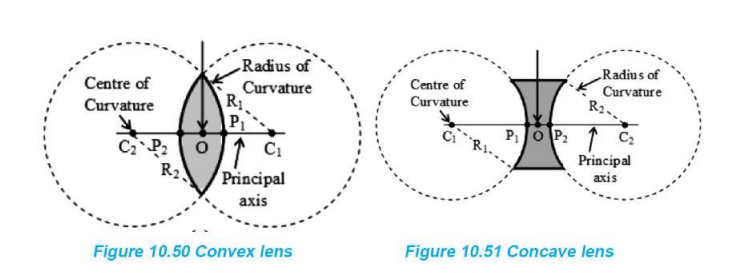
Lens: Transparent medium that has at least one spherical surface.
Types of Lenses
1. Convex Lens (Converging Lens):
- Thicker at middle than at edges
- Converges light rays to a point
- Also called converging lens
- Used in: spectacles, cameras, microscopes, projectors, human eye
2. Concave Lens (Diverging Lens):
- Thinner at middle than at edges
- Diverges light rays
- Also called diverging lens
Subtypes
Converging Lenses:
- Biconvex
- Plano-convex
- Concavo-convex
Diverging Lenses:
- Biconcave
- Plano-concave
- Convexo-concave
Lens Terminology
- Center of Curvature (C): Center of sphere forming curved part of lens (C₁ and C₂ for two surfaces)
- Radius of Curvature (R): Distance from center of curvature to lens surface
- Optical Center (O): Geometrical center of lens where principal axis intersects lens
- Principal Axis: Line passing through optical center and both centers of curvature
- Principal Focus (F):
- Convex lens: Point where parallel rays converge after passing through lens
- Concave lens: Point from where parallel rays appear to diverge
- Focal Length (f): Distance from optical center to principal focus
- Convex lens: Positive focal length
- Concave lens: Negative focal length
- Relationship: Radius of curvature = 2 × Focal length (R = 2f)
Ray Diagram Rules for Lenses
Rules for Drawing Ray Diagrams
- Through Optical Center: Light rays passing through optical center continue in straight line without bending
- Parallel to Principal Axis:
- Convex lens: Rays converge and pass through focus
- Concave lens: Rays appear to diverge from focus
- Through Focus: Light rays passing through focus emerge parallel to principal axis after refraction
Key Observations
- As object moves closer to convex lens, image size increases
- As object moves away from convex lens, image size decreases
Image Formation by Concave Lens
For any object position:
- Image Position: Same side as object, between F and O
- Image Characteristics: Virtual, erect, diminished
- Application: Door peephole
Reason: Refracted rays diverge and never physically intersect; when extended backward, they appear to meet forming virtual image.
Power of a Lens
Definition
Power of Lens: The ability of a lens to converge or diverge light rays.
Mathematical Formula
Power (P) = 1 / f (in meters)
Where f = focal length in meters
Unit
Diopter (D): SI unit of lens power
Sign Convention
- Convex lens: Positive power (e.g., +2.5 D)
- Concave lens: Negative power (e.g., -4 D)
Relationship with Focal Length
- Shorter focal length → Higher power → Greater converging/diverging ability
- Longer focal length → Lower power → Lower converging/diverging ability
Lens Thickness
- Thicker lens → Smaller focal length → Higher power
- Thinner lens → Larger focal length → Lower power
Human Eye
Definition
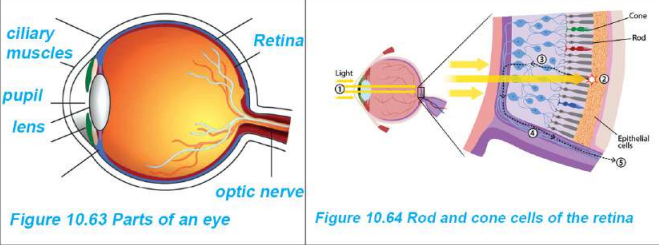
Human Eye: Natural optical instrument that forms images of objects by refracting light through a convex lens.
Structure and Parts
1. Cornea:
- Transparent layer in front of eye
- Allows light to enter
- Main refracting surface (bends light more than any other part)
- Acts like main lens of eye
- Refractive index: 1.376
- Converging power: +43 D (about 2/3 of eye's total refracting capacity)
2. Pupil:
- Dark hole in middle of eye
- Entry point for light
- Size changes according to light brightness
- Controlled by iris muscles
3. Iris:
- Colored muscular layer around pupil
- Controls pupil size
- Bright light: Muscles relax, pupil becomes smaller
- Dim light: Muscles contract, pupil becomes wider
4. Eye Lens:
- Transparent convex lens
- Made of natural protein called crystalline
- Further refracts light from cornea
- Focuses light onto retina
5. Ciliary Muscles:
- Flexible muscles attached to lens
- Change thickness and curvature of lens
- Enable focusing on near and distant objects
6. Retina:
- Light-sensitive layer at back of eye
- Detects color and brightness of light
- Contains two types of cells:
- Rod cells: Detect brightness, convert light to electrical signals
- Cone cells: Detect and identify colors (red, green, blue)
7. Aqueous Humor and Vitreous Humor:
- Fluids that give eye spherical shape
- Help maintain eye structure
8. Optic Nerve:
- Bundle of nerve cells
- Transmits image information to brain as electrical signals
Image Formation
- Inverted image forms on retina
- Brain inverts it again so we see objects right way up
Accommodation of Eye
Definition
Accommodation: Process of adjusting focal length of eye lens according to object distance by relaxation and contraction of ciliary muscles.
Mechanism
Viewing Distant Objects:
- Ciliary muscles relax
- Lens becomes thinner
- Curvature decreases
- Focal length increases
- Rays focused on retina
Viewing Nearby Objects:
- Ciliary muscles contract
- Lens becomes thicker
- Curvature increases
- Focal length decreases
- Rays refracted more strongly and focused on retina
Key Point
- Image distance (lens to retina) remains constant
- Lens curvature changes to maintain focus on retina
Range of Human Vision
Far Point
Definition: Farthest distance from eye at which objects can be seen clearly.
- Normal eye: At infinity (∞)
- Lens is thinnest with maximum focal length
Near Point
Definition: Nearest distance from eye at which objects can be seen clearly.
- Normal eye: 25 cm from eye
- Also called Least Distance of Distinct Vision
- Lens has maximum curvature (thickest) with shortest focal length
Normal Vision Range
25 cm to infinity (∞)
Note: Near point varies with age and eye condition.
Defects of Vision
Definition
Defect of Vision: Phenomenon where nearby or distant objects appear blurry because light rays don't focus exactly on retina.
1. Shortsightedness (Myopia)
Symptoms
- Distant objects appear blurry
- Nearby objects seen clearly
- Far point is at finite distance (not at infinity)
Causes
Primary Causes:
- Elongated eyeball: Distance between lens and retina increases
- Insufficient ciliary muscle relaxation: Lens cannot become thin enough for distant objects
Result: Parallel rays from distant objects focus in front of retina instead of on it.
Correction
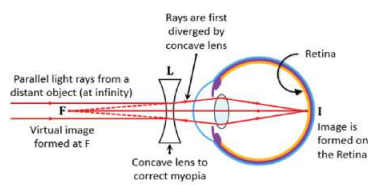
- Use concave lens (diverging lens) of suitable focal length
- Concave lens diverges incoming parallel rays before they enter eye
- Diverged rays then refracted by eye lens and focused on retina
- Focal length selected so rays appear to come from far point F of defective eye
2. Longsightedness (Hypermetropia)
Symptoms
- Nearby objects appear blurry
- Distant objects seen clearly
- Near point is beyond 25 cm
Causes
Primary Causes:
- Too circular eyeball: Distance between lens and retina decreases
- Insufficient ciliary muscle contraction: Lens cannot become thick enough for nearby objects
Result: Rays from nearby objects focus behind retina.
Note: Usually seen in old age.
Correction
- Use convex lens (converging lens)
- Convex lens converges rays from nearby objects before they enter eye
- Converged rays refracted by eye lens and focused on retina
- Focal length selected so rays appear to come from near point N of defective eye
Alternative Vision Correction Methods
1. Contact Lenses
Description: Thin artificial lens worn on cornea surface
Advantages:
- No distortion of peripheral vision
- Moves with cornea
- Lower power needed compared to spectacles
- Suitable for sports and active lifestyles
Disadvantages:
- Requires careful handling
- Must be cleaned and disinfected regularly
- Risk of corneal infection if not properly maintained
- Cannot sleep with contact lenses overnight
Safety Precautions:
- Wash hands before wearing and removing
- Store and clean properly
- Never reuse without disinfection
2. Laser Eye Surgery
Definition: Process of correcting vision defects by reshaping cornea using ultraviolet laser (excimer laser).
Most Popular Technique: LASIK (Laser-assisted in situ keratomileusis)
For Shortsightedness:
- Laser beam focused on central part of cornea
- Cornea flattened slightly
- Light refracted less through cornea
- Myopia corrected
For Longsightedness:
- Laser beam focused on edges of cornea
- Middle part of cornea raised slightly
- Light refracted more through cornea
- Hypermetropia corrected
Process:
- Laser cuts flap in outer cornea
- Flap flipped to reshape cornea
- Permanent correction
Other Eye Problems
1. Cataract
Definition: Gray-colored spot in pupil due to cloudiness of lens.
Causes:
- Crystalline proteins stick together with age
- Lens becomes cloudy and opaque
- UV radiation exposure
- Cigarette smoking
- High diabetes
Symptoms:
- Objects appear blurry
- Light doesn't reach retina properly
- Progressive loss of vision
- Complete blindness if untreated
Treatment: Cataract Surgery
- Fine hole made on edge of cornea
- Cloudy lens broken into small pieces using ultrasound
- Pieces removed with vacuum tube
- Intraocular lens (IOL) made of silicone/acrylic implanted
Historical Note: Dr. Sanduk Ruit (Nepali Ophthalmologist) developed cheap intraocular lens in 1995, making cataract treatment affordable.
2. Color Blindness
Definition: Inability to distinguish certain colors due to defects in cone cells of retina.
Mechanism:
- Three types of cone cells: red, green, blue
- Each type absorbs specific color wavelength
- Message sent to brain about observed color
- If cone cells don't work, cannot distinguish colors
Types:
- Red-green color blindness: Most common, cannot distinguish red and green
Causes:
- Heredity: Main reason
- Mutation destroying cone cells
- Exposure to harmful rays
Note: Cannot be cured; permanent condition.
3. Night Blindness (Nyctalopia)
Definition: Inability to see well at night or in dim places.
Mechanism:
- Rod cells enable vision in dim light
- Rhodopsin pigment in rod cells made from protein and vitamin A
- Problem with retina, not lens
Causes:
- Vitamin A deficiency (main cause)
- Disease or injury to rod cells
- Lack of proper nutrients
- Heredity
Prevention: Adequate vitamin A intake
Corneal Problems
Importance of Cornea
- Maximum refraction occurs at cornea (about 2/3 of eye's refracting capacity)
- Refractive index: 1.376
- Converging power: +43 D
- Must be protected from scratches and injuries
Common Corneal Injuries and Diseases
1. Corneal Scratches:
- Caused by rubbing eyes when dust/sand enters
- Stones, metal pieces, accidents
- Continual use of contact lenses without proper cleaning
2. Corneal Ulcer (Keratitis):
- Caused by bacterial, viral, or fungal infections
- If untreated, leads to blindness
- Requires immediate treatment
3. Corneal Edema:
- Fluid accumulation between corneal layers
- Causes blurred vision
4. Keratoconus:
- Cornea changes to conical shape
- First causes shortsightedness
- Eventually leads to vision loss
Treatment
- Normal problems: Proper medical treatment
- Severe cases: Corneal transplantation
Corneal Transplantation
Definition
Process of replacing damaged cornea with healthy cornea through eye surgery.
Indications
- Born with puffy eyes
- Cornea damaged due to infections
- Injuries without immediate treatment
- Corneal degeneration (second leading cause of blindness in Nepal after cataract)
Eye Donation Process
- People donate eyes to eye bank before death
- After death, cornea (not whole eye) removed within 8-12 hours
- Eyelids closed to protect cornea from sunlight
- Cornea stored safely
- Transplanted to person in need
In Nepal
Nepal Eye Bank: Established under Tilganga Eye Institute for collection, storage, and distribution of corneas.
Summary of Key Formulas
Refractive Index
μ = c / v μ = sin i / sin r
Power of Lens
P = 1 / f (in meters) Unit: Diopter (D)
Relationship
Radius of curvature = 2 × Focal length R = 2f
Important Constants
- Speed of light in vacuum/air: 3 × 10⁸ m/s
- Near point of normal eye: 25 cm
- Far point of normal eye: Infinity (∞)
- Refractive index of cornea: 1.376
- Converging power of cornea: +43 D
Key Concepts to Remember
- Light travels fastest in vacuum/air and slowest in diamond
- Optically denser ≠ physically denser
- Total internal reflection requires: (a) denser to rarer medium, (b) angle of incidence > critical angle
- Dispersion occurs due to different speeds of different colors in medium
- Convex lens converges; concave lens diverges
- Eye accommodation maintains focus despite changing object distances
- Myopia corrected with concave lens; hypermetropia with convex lens
- Cornea performs most of eye's refraction (2/3)
- Rod cells for dim light; cone cells for color
- Rainbow forms due to refraction, total internal reflection, and dispersion in water droplets
- Image Formation by Convex Lens
Gallery
Color from the sodium vapour light
Color from the sodium vapour light
Convex and Concave lens
Convex and Concave lens

Terminologies related to lens
Terminologies related to lens
Eye
Eye
Correction of shortsightedness
Correction of shortsightedness
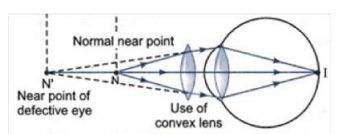
Correction of longsightedness
Correction of longsightedness